

Why was the Berlin Wall Built?
The Berlin Wall: Origins, Purpose, and Implications
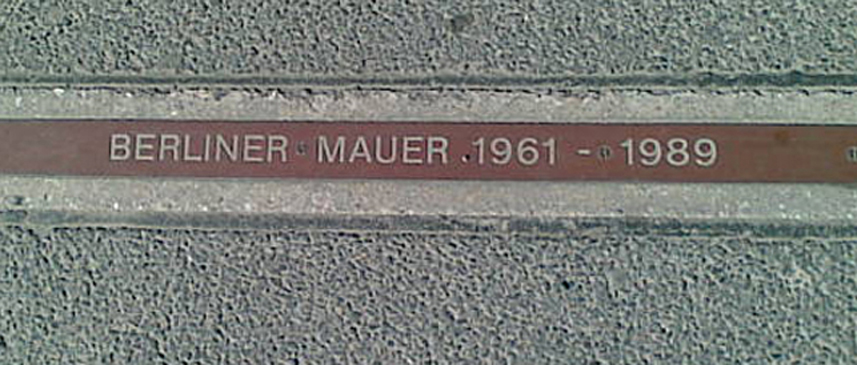
A plaque near Checkpoint Charlie signifying where the Wall stood.
Firstly, the construction of the Berlin Wall in 1961 was a watershed moment in Cold War history. Thus, serving as both a literal and metaphorical barrier between East and West, the Wall came to symbolize the profound ideological, political, and economic divides of the 20th century. Understanding the reasons behind its construction requires an exploration of post-World War II geopolitics, the division of Germany, and the fears and aspirations of the Soviet Union and its Eastern Bloc allies.

A memorial of over a thousand crosses and a segment of the Wall for those who died trying to cross. Additionally, the memorial stood for ten months from 2004 to 2005.
1. Contextual Background: Post-WWII Germany
At the end of World War II, the Allies (the U.S., the UK, France, and the Soviet Union) divided Germany into four zones of occupation. Berlin, the capital. Similarly split. However, even though it was deep within the Soviet zone. This arrangement found itself enacted. Moreover, supposedly to become temporary. As a result of enacting the idea of “de-Nazify and democratize Germany.” Nevertheless, emerging Cold War tensions quickly solidified these divisions.
2. The Emergence of Two Germanys

October 7, 1961. Moreover, four-year-old Michael Finder of East Germany, tossed by his father into a net held by residents across the border in West Berlin. In addition, the father, Willy Finder, prepares to make the jump himself.
By the late 1940s, it became apparent that Germany was moving toward permanent division. In the West, the American, British, and French zones merged to form the Federal Republic of Germany (West Germany) in 1949, characterized by a capitalist economy and a democratic political system. In response, the Soviet zone became the German Democratic Republic (East Germany), a socialist state aligned with the USSR.
3. East-West Migration
While the East German state officially touted the benefits of socialism, many of its citizens yearned for the freedoms and economic opportunities they saw in the West. Between 1949 and 1961, approximately 2.5 million East Germans, including a disproportionate number of young, educated professionals, defected to West Germany, often through West Berlin. This “brain drain” threatened the very viability of East Germany.
4. Soviet and East German Fears
The open border in Berlin was a liability for the USSR and its allies. Additionally, not only was it an embarrassment when juxtaposed against the supposed “superiority” of socialism, but it also posed a security risk. Moreover, Western spies could easily enter East Berlin, and NATO forces could potentially exploit this access point in a conflict.
5. The Construction of the Wall
On the night of August 12-13, 1961, East German troops began erecting a barbed-wire barrier around West Berlin. Which quickly became replaced by a 12-foot-high concrete wall. Ostensibly, East German officials claimed it was an “Anti-Fascist Protective Wall” to prevent western “fascists” from undermining the socialist state. In reality, its primary function was to halt the mass exodus of East Germans to the West.
6. Implications
The Wall’s construction solidified the division of Europe. Families became separated. Furthermore, East Germans found themselves isolated. In addition, many who attempted to flee to the West became arrested or killed. For the West, the Wall was a potent symbol of communist oppression, and thus, it became a focal point in Cold War rhetoric. U.S. President Ronald Reagan’s plea to Soviet leader Mikhail Gorbachev in 1987 to “tear down this wall!” exemplified this sentiment.
In a broader sense, the Wall served as a physical manifestation of the “Iron Curtain” that Winston Churchill had spoken of in 1946, demarcating the ideological battle lines of the Cold War.
Conclusion

Structure of the Berlin Wall (left to right) Border Outer strip Concrete wall moreover, with rounded top Anti vehicle ditch “Death strip” sand bank Guard road Lighting Observation towers Spikes or tank traps Electrified fence with alarms Inner wall Restricted zone
The Berlin Wall stood for 28 years, not just as a barrier between East and West Berlin but as a stark symbol of a world divided. Its construction was borne out of a mix of geopolitical considerations, the exigencies of the East German state, and the deep-seated ideological rifts of the 20th century. When the Wall finally fell in 1989, it marked the beginning of the end of the Cold War, heralding a wave of democratization across Eastern Europe and a reimagining of global geopolitics.
Though today the Wall exists primarily in fragments and memories, understanding its origins and significance is crucial for comprehending the broader Cold War narrative and lastly, its lasting impacts on the world.
Why was the Berlin Wall Built? Why was the Berlin Wall Built?
History, Dates & the Fall | HISTORY
Why the rose—and how it fell (nationalgeographic.com)
Why was the Built? | Gale Archives Explored


