

What lasers do the military use?
The military uses a variety of lasers for different purposes, such as communication, targeting, and defense. Some of the types of lasers used by the military include:
Chemical lasers: These lasers use chemical reactions to produce a high-powered beam of light. Used for targeting and defense purposes.
Solid-state lasers: These lasers use solid materials like crystals or glass as the lasing medium. Useful for range finding, targeting, and weapons systems.
Fiber lasers: These lasers use optical fibers as the lasing medium. Used for communication and targeting purposes.
Gas lasers: These lasers use a gas as the lasing medium. Used for range finding, targeting, and defense purposes.
Diode lasers: These lasers use a semiconductor as the lasing medium. Useful for targeting and defense purposes.
The exact types of lasers used by the military often remain classified and do not become publicly disclosed. However, it is known that they use a combination of different types of lasers depending on the application.

In military technology speak, the “valley of death” refers to a stage in the development of a new military technology. The technology sits at a point too advanced for current operational needs, however, not advanced enough to be fully effective in the field. This stage often becomes characterized by a lack of funding and support. As well as a lack of interest from potential users.
During this stage, military technologies often become seen as risky investments!
https://googleads.g.doubleclick.net/pagead/ads?client=ca-pub-9086844945731243&output=html&h=280&adk=2460326745&adf=205956334&pi=t.aa~a.811624245~i.9~rp.4&w=787&fwrn=4&fwrnh=100&lmt=1682215284&num_ads=1&rafmt=1&armr=3&sem=mc&pwprc=6954126746&ad_type=text_image&format=787×280&url=https%3A%2F%2Fwww.rebellionresearch.com%2Fvalley-of-death-holds-back-military-lasers&fwr=0&pra=3&rh=197&rw=787&rpe=1&resp_fmts=3&wgl=1&fa=27&uach=WyJXaW5kb3dzIiwiMTAuMC4wIiwieDg2IiwiIiwiMTEyLjAuMTcyMi40OCIsW10sZmFsc2UsbnVsbCwiNjQiLFtbIkNocm9taXVtIiwiMTEyLjAuNTYxNS4xMjEiXSxbIk1pY3Jvc29mdCBFZGdlIiwiMTEyLjAuMTcyMi40OCJdLFsiTm90OkEtQnJhbmQiLCI5OS4wLjAuMCJdXSxmYWxzZV0.&dt=1682215284883&bpp=8&bdt=858&idt=8&shv=r20230418&mjsv=m202304130102&ptt=9&saldr=aa&abxe=1&cookie=ID%3Dd498cea9514681f8-2202fe39ded80081%3AT%3D1670443269%3ART%3D1670443269%3AS%3DALNI_MZcZGZ5-JBGv23fmevNbrDm265zFA&gpic=UID%3D000008c6ce02ea23%3AT%3D1670443269%3ART%3D1682210778%3AS%3DALNI_MYCN-ywjFyS-0Zxjy_mFtMCmHX_sQ&prev_fmts=0x0&nras=2&correlator=4567762815501&frm=20&pv=1&ga_vid=2020341257.1651576472&ga_sid=1682215285&ga_hid=1768824524&ga_fc=1&u_tz=-240&u_his=4&u_h=720&u_w=1280&u_ah=680&u_aw=1280&u_cd=24&u_sd=1.5&dmc=8&adx=211&ady=1672&biw=1208&bih=577&scr_x=0&scr_y=0&eid=44759876%2C44759927%2C44759842%2C31073968%2C31074012&oid=2&pvsid=801853627684418&tmod=856118995&wsm=1&uas=0&nvt=1&ref=https%3A%2F%2Fwww.rebellionresearch.com%2F%3Fs%3Dlaser&fc=1408&brdim=0%2C0%2C0%2C0%2C1280%2C0%2C1280%2C680%2C1223%2C577&vis=1&rsz=%7C%7Cs%7C&abl=NS&fu=128&bc=31&ifi=2&uci=a!2&btvi=1&fsb=1&xpc=bQ5YSeFJJM&p=https%3A//www.rebellionresearch.com&dtd=24
Both the military and private investors develop cold feet on promising new tech. Lockheed will worry about the government following through. As they won’t have a clear path to commercial viability while investing a ton in R&D. As a result, many promising military technologies never make it past the valley of death. And thus never deploy in the field.
This week the Government Accountability Office released a report looking at the directed-energy-program transition plans for the Army, Navy, and Air Force,
“Despite the challenges for transitioning technologies, prior DOD and GAO work found that this gap can become bridged through cooperative efforts.” Furthermore, the GAO report states; “Technology development officials can make decisions that balance needs, resources and technical feasibility in a way that is responsive to the end-user. Acquisition programs and intended end-users can provide early project endorsement, and communicate measurable performance metrics for the technology to achieve.” https://www.gao.gov/products/gao-23-105868
“If ever there was a weapon system capability that needed moving across the VOD, Directed Energy is it.” According to Mark E. Solomons, Office of the Undersecretary of Defense for Research and Engineering.

Anthony Cowden, a former U.S. Navy Surface Warfare Officer asks; “Has the Navy demonstrated a prototype directed energy CIWS that can defeat as many ASCMs as Phalanx, RAM, or SeaRAM?”
A former US Navy Test & Evacuation Officer mentioned; “I thought the most alarming part of the GAO report was this recommendation: ‘The Secretary of the Navy should ensure the Assistant Secretary of the Navy for Research, Development and Acquisition documents how the Navy collects, tracks, and incorporates DE prototype user feedback during development and testing.’ Troubling to think that the testing/demonstrating is taking place but there’s a lack of relevant data being collected or documented.”
Kwok-Keung Law, Head of Optics & Photonics for the US Naval Air Warfare Center said; “Didn’t see the key reasons mentioned in the article about why the Air Force or Navy Air Force can’t transition the HELs because of the size and weight still too big and heavy to be integrated with any tactical aircrafts. Maybe armed services, especially those which use tactical aerial vehicles, don’t have a plan for transition due to a very simple and straightforward reason. It is because the SWaPs of the lasers are still way way too high. Perhaps the most viable HEL transition path for the aerial platforms is to reduce the current HEL systems. I.e., including cooling and power supplies by at least 4 to 5X. Are any HEL defense contractors working to achieve this goal? I haven’t seen any. Please correct me if there is a defense contractor now doing R&D to reduce the SWaP of HELs by at least 4X for a given required brightness/power for the intended lethality.”
Craig Pichach of Anodra Energy is negative on the whole concept; “I just can’t help but give up on the concept of directed energy working at extended range (leave that to the kinetic mass drivers that can’t get across the ‘valley of death’).. that maybe we just have to accept that the place for it is super cheap, super accurate point defense weapons. I know it seems uncomfortable that you would be trusting your ability to shoot down a lot of incoming high speed incoming projectiles in the last 5 seconds, but if you shoot them all down for pennies on the dollar and live to tell the tale… mission accomplished (and what a surprise for the opposition?)?”
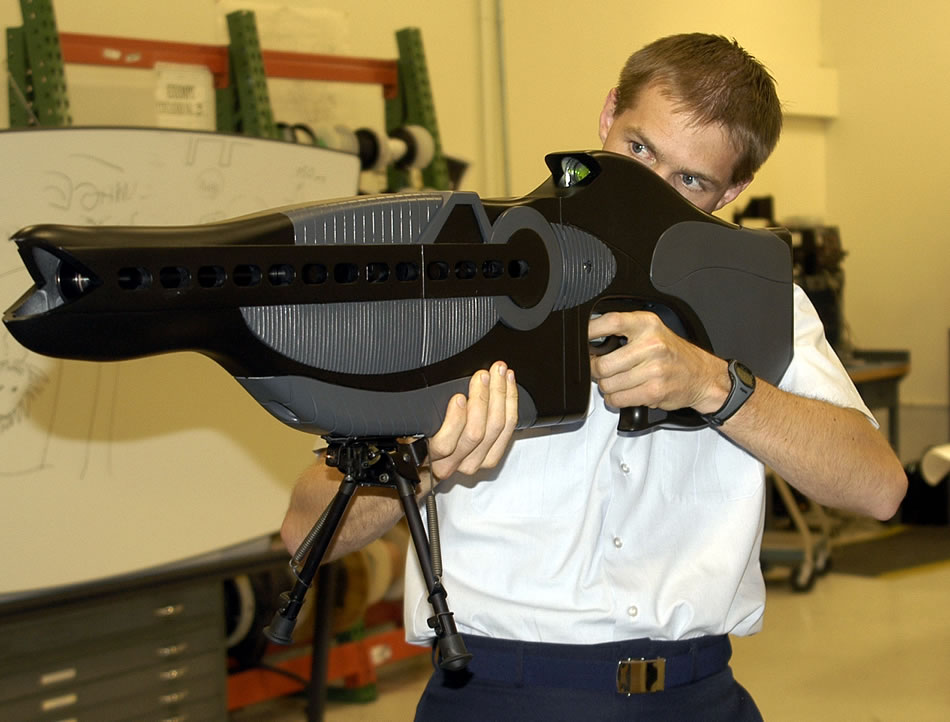
Air Force Research Laboratory Directed Energy Directorate Public Affairs Photo released by the U.S. Air Force. – http://www.af.mil/news/story_media.asp?storyID=123012699; archived at: https://archive.is/20120721195102/http://www.af.mil/news/story.asp?storyID=123012699

Yal 1A AIrborne Laser Aircraft conducts initial ball rotation tests at Western Test Range
What lasers do the military use?
Real Laser Weapons Used by the US Military – YouTube
This is the laser that Marines have chosen to dazzle, hail and warn (marinecorpstimes.com)
What Qualifies as a Military Grade Laser? Beam Power vs Frequency. (biglasers.com)
What lasers do the military use?


