

What is the origin and evolution of math?
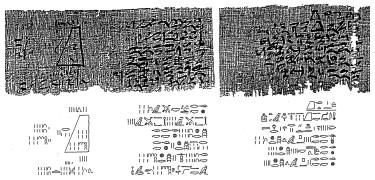
Image of Problem 14 from the Moscow Mathematical Papyrus. The problem includes a diagram indicating the dimensions of the truncated pyramid.
Let’s take a look!
The Origin and Evolution of Mathematics
Mathematics, often termed the “queen of the sciences,” boasts a history as rich and expansive as human civilization itself. Rooted in everyday problems, mathematics has evolved over millennia, shaping and being shaped by human culture, science, and philosophy. The intricate tapestry of mathematical development weaves together threads from ancient civilizations to the digital era, illustrating a discipline ever in flux, expanding and adapting to the needs and insights of each epoch.
Ancient Beginnings
The origin of mathematics can become traced back to ancient civilizations. Such as the Sumerians, Egyptians, and Indus Valley inhabitants. For these early societies, math emerged out of necessity. The challenges of trade, land measurement, and the construction of monumental architectures like the Egyptian pyramids demanded accurate record-keeping and measurement techniques.
- Sumerians and Babylonians: The Sumerians, around 4000 BCE. Became credited with introducing the first number system, which the Babylonians later developed. This system was positional and base-60, a precursor to our present-day base-10 system. The Babylonians also made significant strides in algebra and geometry.
- Egyptians: The Rhind Papyrus, dated around 1650 BCE, is one of the most ancient mathematical texts from Egypt. It includes problems on fractions, algebra, geometry, and trigonometry, showing the advanced level of Egyptian mathematics.
Classical Foundations
The mathematical torch was then passed to ancient Greece, where foundational work laid the bedrock for Western mathematics.
- Pythagoras and the Pythagoreans: This mystical sect is famed for the Pythagorean theorem but contributed much more. They delved into number theory, establishing concepts about prime numbers and perfect numbers.
- Euclid: His magnum opus, “Elements,” written around 300 BCE, was a compilation of known mathematics, including geometry and number theory. Its axiomatic approach served as the gold standard for mathematical proofs for centuries.
- Archimedes: Often regarded as one of the greatest mathematicians, Archimedes made profound contributions in geometry, calculus, and the understanding of levers and pulleys.
Medieval Flourish
The fall of the Roman Empire saw the center of mathematical innovation shift to the Islamic world.
- Islamic Golden Age: From the 8th to the 13th centuries, scholars like Al-Khwarizmi, who introduced algebra (derived from the Arabic word “al-jabr”), and Omar Khayyam, who worked on cubic equations, carried forward the mathematical legacy.
- India: Parallel developments occurred in India, where ancient texts like the Sulba Sutras and works of mathematicians like Aryabhata and Brahmagupta introduced concepts of zero, decimals, and various trigonometric functions.
Renaissance to Modern Era
The European Renaissance witnessed a renewed interest in mathematics, dovetailing with scientific exploration.
- Calculus: The 17th century saw the independent development of calculus by Sir Isaac Newton and Gottfried Wilhelm Leibniz. This new branch of math would underpin much of modern physics and engineering.
- Modern Math: The 18th and 19th centuries ushered in areas like probability, number theory, and group theory. Mathematicians like Leonhard Euler, Carl Friedrich Gauss, and Georg Cantor expanded the mathematical horizon, setting the stage for the 20th century’s forays into set theory, topology, and abstract algebra.
Present Day and Beyond
Today’s math is characterized by increasing specialization and abstraction. But with technological advancements, especially in computer science, there’s a symbiotic relationship wherein mathematical theories guide technological progress, and technological problems, in turn, push mathematical boundaries.
Fields like cryptography, which ensures secure communication, are deeply rooted in number theory. Meanwhile, challenges in artificial intelligence and quantum computing are leading to fresh mathematical insights.
Conclusion
Lastly, from the rudimentary arithmetic of ancient merchants to the sophisticated abstractions of contemporary mathematicians. Moreover, the journey of mathematics mirrors the intellectual evolution of humanity. As history demonstrates, mathematics will continue to evolve, reflecting the challenges. In addition, aspirations, and innovations of each epoch. Thus, reaffirming its enduring significance in shaping the tapestry of human civilization.


