

What is the meaning of Scream by Edvard Munch?

An Infinite Scream Course Through Nature
In the Wechat emoji renderings, there is one whose mouth hangs wide open, with two hands on both sides of the face, screaming. This frequently used emoji: Terror in Wechat, made to resemble the subject of The Scream, one of the most celebrated and recognized images in the world of art. Its popularity became so high that in numerous forms it has become reproduced. Furthermore, referenced, and remodeled, demonstrating that the charm of Munch’s original artwork can’t be summed up in a cliché. Among the galaxies of artworks in the 19th century, the Scream consistently stands out due to its powerful artistic expression, pioneering artistic form, and resonant artistic motif.
To begin with, The Scream’s artistic expression largely promoted by the amazing composition and ingenious utilization of the lines and colors.
In the foreground of the image is a dehumanized figure shouting and twisting in pain. To enhance the expression, the painter employed his trademark device:
“The figure is cut by the lower edge of the frame, appearing to have the tendency of breaking the fourth wall, engaging not only the spectator, but the medium itself” (Kissel, 2007).
Besides, there are “curving and explosive strokes” across the surface, delivering “a high impact on the viewers by visualizing the acoustic wave” (Honour & Fleming, 2015, 721).
Additionally, the wide use of saturated colors in the background further depresses the whole image, making the scream even more miserable as it spreads into the intense combination of deep gray, bright orange, and bloody red distance. The Scream is so expressive that the visual perception, in this case, must “proceed through to an acoustic one”, which means that
“you haven’t actually perceived it until you’ve heard a scream – an incessant scream which makes you tremble” (Welsch, 2000).
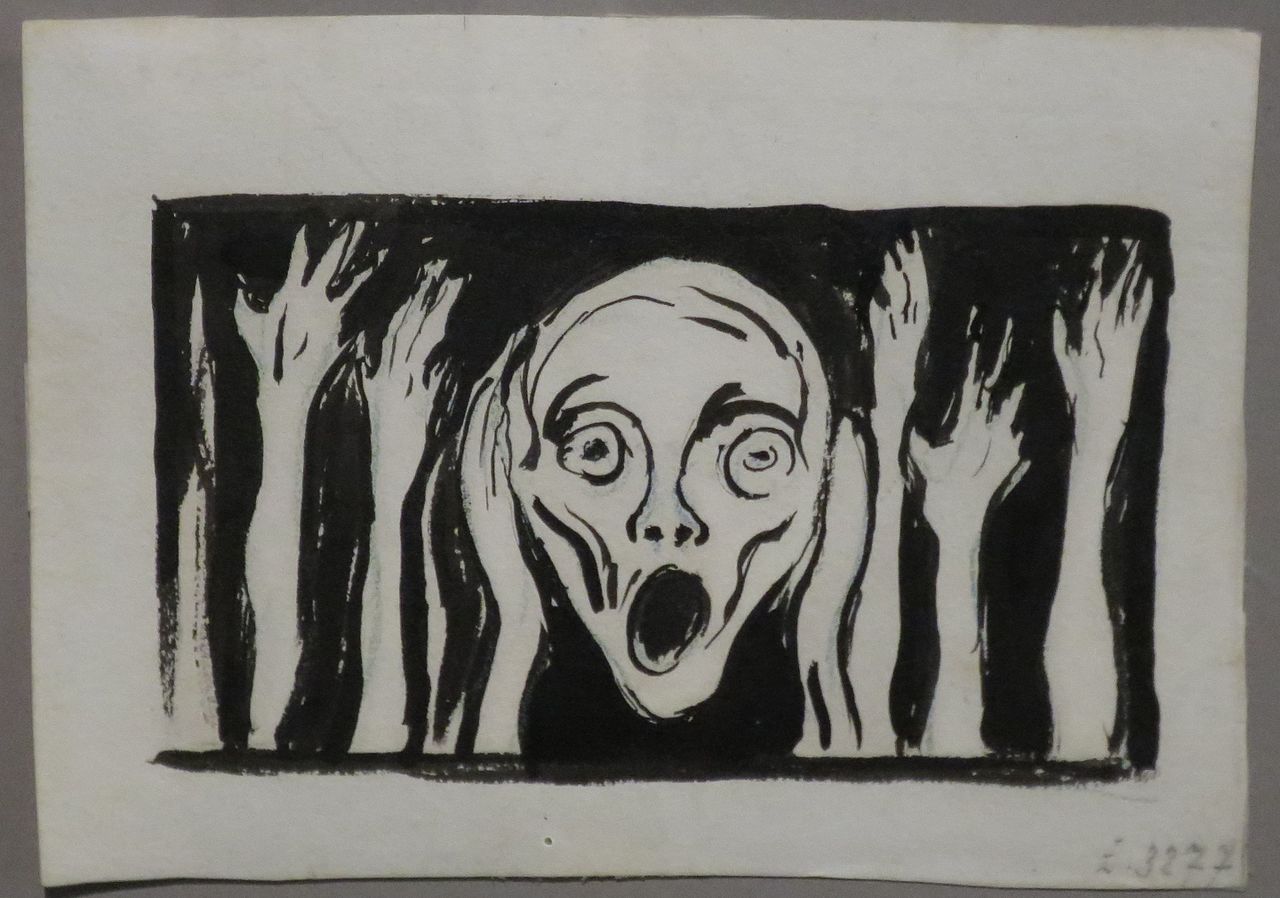
The pioneering role it plays in the Expressionist Movement also contributes to the significance of The Scream within the annals of modern art. While Monet’s work stems from the observation of the natural world, Munch’s The Scream focuses on the expression of the tormented inner world, eventually giving birth to an artistic form, which were defined as Expressionism later.
Furthermore, the Web Museum (2002) defines Expressionism as a “movement in fine arts that emphasized the expression of inner experience rather than solely realistic portrayal, seeking to depict not objective reality but the subjective emotions and responses that objects and events arouse in the artist.”
The innovative way in which Munch portrayed raw, pure emotion within The Scream is considered as a radical turning point, from the visual interpretation of the material universe to the expression of most intimate feelings, making him the precursor of 20th century Expressionism.
Finally, resonance can become easily found in The Scream, owing to Munch’s dauntlessness to express his emotions.

“The Scream is an icon of modern art, a Mona Lisa for our time.” as Arthur Lubow (2006) described, “As Da Vinci evoked a Renaissance ideal of serenity and self-control, Munch defined how we see our own age – wracked with anxiety and uncertainty.”
Created at the close of the 19th century, The Scream reflected the common mindsets of young people whose God had died, while materialism seldom offered enough comfort.
In conclusion, a hundred years passed, the agony and isolation Munch experienced still exists. Moreover, or even aggravated by the more and more hurried lifestyle. Unfortunately, few people nowadays dare to scream it out, for personal anxiety seems to be of little significance in a huge collective hysteria. As a result, when appreciating this masterpiece of pure dread and anguish. Lastly, a scream coming from one’s own throat can actually become heard.
With its powerful artistic expression, pioneering artistic form, and resonant artistic motif, The Scream undoubtedly deserves its everlasting fame.
Moreover, on January 22nd, 1892, Munch wrote in his dairy:
“…and I stood there trembling with anxiety …and I sensed an infinite scream course through nature” (“The Scream,” n.d.). Through The Scream, we sense it too.
What is the meaning of Scream by Edvard Munch?
References
Honour, H., Fleming, J. (2015). World Art History. Beijing: Beijing Fine Arts Photography Publishing House.
Kessel, J. (2007, November 26). Edvard Munch: The Scream. Retrieved from http://artandcritique.com/edvard-munch-the-scream/
Lubow, A. (2006, March). Edvard Munch: Beyond The Scream, Smithsonian Magazi-ne. The Scream. (n.d.). In Wikipedia. Retrieved from https://en.wikipedia.org/wiki/The_Scream WebMuseum: Expressionism. (2002). Retrieved from http://www.ibiblio.org/wm/paint/glo/exp ressionism/ Welsch, W. (2000). Aesthetics Beyond Aesthetics. Retrieved from http://proxy.rz.uni jena.de/welsch/Papers/beyond.html.


What is the meaning of Scream by Edvard Munch?


