

What is the difference between foreign and domestic policies?
Society

A view from the left!
Foreign and domestic policy are inextricably linked. America’s actions abroad are a reflection of underlying sentiment at home, and at the same time, those beliefs and attitudes shaped by our influence on the international stage. Over the past decades, our foreign policy has largely been shaped by how we began the War on Terror, and have adjusted our lives around it. Spencer Ackerman’s Reign of Terror and Samuel Moyn’s Humane offer nuanced insights about how our engagement in this prolonged war has ingrained in America both a sense of exceptionalism in the humanity of our conflicts and also an underlying nativism in our constant state of defensiveness — which has ultimately driven divisiveness at home.
The road to the War on Terror is paved with the beginning of air bombing.
Inherently, bombing enables violence from a distance, and that distance prevents perpetrators from truly understanding their enemies as individual human beings, rather than a collective, valueless enemy. Not only does it dehumanize targets, but it also brings civilians into war; in ground campaigns, targeting urban centers is logistically difficult and barbaric, but in bombing runs, their demolition is an opportunity to crush morale. This inherent inhumanity is on full display in the Vietnam war when the U.S. military targets “free-strike” zones where anyone in a designated area — no matter if they have any affiliation to the enemy or not — is marked for death.
Indiscriminate brutality from the air combined with massacring civilians on the ground (most notably in My Lai), prompted outrage from the public.
But focusing criticism on the human rights violations is what sets Moyn’s overarching argument about humanizing war in motion; while the American public was indignant over how the war was fought, they were less concerned with why we entered the war in the first place. The willingness of the U.S. military to engage in conflict was never questioned, and in later conflicts was even supported. During the Clinton administration, the U.S. military was criticized for not getting involved early enough in Kosovo to prevent needless death, despite the lack of legal justification for any intervention at all; it was our moral obligation to intervene. It is clear that before the war on terror, exceptionalist fervor motivating lawless military engagements and undercurrents of nativism justifying brutality towards enemies were guiding foreign policy.
After 9/11, those fears would become exacerbated.
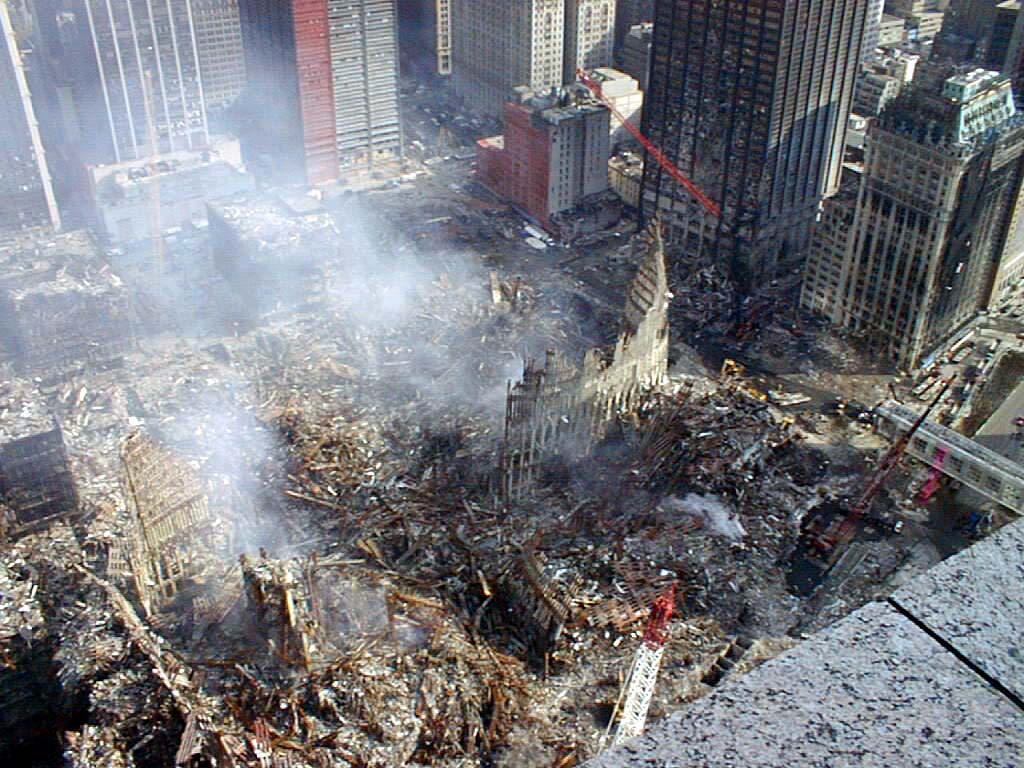
NOAA – NOAA: (http://www.noaanews.noaa.gov/stories/images/groundzero.jpg
The U.S. immediately launches into a new war, one with no legal precedence. Fighting against non-state actors, the U.S. wasn’t sure exactly who they were fighting, where, for how long, and for what end goal. Without any clearly defined enemy, and guided by those inflamed nativist sentiments, American media declares a messianic war against Islam as a whole. Americans begin to reject Islamic institutions such as Al Jazeera and Dubai Ports World, they emphasize the misogynistic practices as an indication of tyranny, and when the Iraq war begins, right-wing media suggests that Iraqi citizens should thank the U.S. military for their service of liberating them from their tyranny.
Any pushback regarding the decision to go to war was stamped out. Susan Sontag suggested that the root cause for 9/11 lay in America’s previous involvements in the Middle East.
She became vilified.
However correct, as the U.S. military would go on to make the same mistake again.
Nonetheless, Americans felt threatened, and although there was no legitimate, imminent threat — the historic justification for military action — the need to take expansive preemptive wartime measures enjoyed enormous support. America was no stranger to lawless initiation of conflict, and the belief that Islam posed an existential threat to everything we stood for, was a blank check for violence.
To aid this burgeoning war effort, John Yoo, assistant attorney general, stripped America’s enemies of any legal protections against war crimes.
As non-state actors, they couldn’t be protected under international laws, and as a foreign threat, they couldn’t be protected under domestic law. Yoo gave state-affiliated actors such as the Taliban little consideration, deeming them “warlords of a failed state”, and thus unqualified for legal protection, which only bolstered nativist narratives. This maximal flexibility in authority led to egregious detainment and torture and “signature strikes” echoing Vietnam’s “free-strikes.” However, this attempt to write off all constraints on wartime aggression combined with leaked reports of heinous human rights violations in Guantanamo created the first considerable resistance to wartime activity.

An American public eager to end these violations and the Iraq war elects an anti-war candidate in Barack Obama. He clearly demarcates the intention to end dumb wars. And end the notion of fighting against all Islam, but to continue fighting against terrorists. He opts for a humane approach to war. Moreover, turbocharging the drone program to take an aggressive, pre-emptive position. While also mitigating collateral damage. He strives to close Guantanamo but struggles with intense pressure from politicians all across the aisle that it is simply too risky to let detainees walk free, even if they have no connection to terrorism.
He ultimately succeeds in killing Osama Bin Laden but chooses not to end the war on terror.
And this is where Moyn presents his full-fledged argument. Obama prolongs this war because the American public will always fear another terrorist attack, and as long as the military strives to fight in a humane way, America will believe it is “on the right side.” Obama’s humane drone warfare only entrenched the U.S. in an intractable conflict where justifying violence only begets fear and more violence.
Ackerman explains that this constant feeling of being under threat from some foreign adversary was so consuming, it warped our domestic institutions, policies, and conscience. These changes began to take root early on in the war in the form of a massive surveillance state empowered by Big Tech’s emergence, indefinite detention without charge, stricter immigration requirements, law enforcement’s infiltration and mass roundups of minority communities, and ICE’s raids on over 4400 Muslim businesses in a year, and even more explicit discrimination by the public such as Birtherism.
They would later manifest more obviously in Trump’s presidency. Doubling down on this wartime attitude and the “right” of the American nation to exercise the full breadth of its power upon Islamic countries, Trump pledged to “bombing the shit out of them,” enacted a sweeping ban on immigration from predominantly Muslim countries, and pardoned war criminals on the basis that crimes cannot be committed against “subhuman” enemies.
Perhaps Ackerman’s greatest concern of all, is how this exhausting, incessant war against an invisible enemy stoked the flames of nativist animosity.

Furthermore, motivated people to turn their anger toward not just Muslims but all minority groups. The consistent lack of any defined enemy led Americans to “merge their grievances.” Grouping all immigrants together as a collective threat, Trump authorized an enormous expansion of ICE. Moreover, American citizens advocating for change through the Black Lives Matter movement became also deemed terrorists by right-wing media and were met with dominating opposition from police with military-grade weapons.
Soon enough, any voice of disagreement with Trump and the identity and attitudes he encouraged, from Ilhan Omar to the security state official investigating his campaign activities and election results, became seen as a threat. That lack of faith in leaders and institutions inspired these Americans to arm themselves and prepare to fight against those they believed to be “undermining the system”, as demonstrated by white supremacist attacks on anti-racism protests such as in Charlottesville and Kenosha.
America’s repeated lawless engagement in war never became questioned, only the fairness of its operations in war.
The more fair and humane we strove to be (as far as fairness and humanity can be achieved in war), the more justified we felt in our position. But, this position had no precision, no specific enemy, and no exit strategy, and so we took as broad of a position as possible, killing every third day with missiles from drones to preemptively prevent harm from ever reaching American soil again. That position only further antagonized our enemies, initiating further conflict just as ISIS branched off from Al-Qaeda, and the endlessness of our wars normalized this broad labeling of all Islam as an enemy, giving reason to consider all foreigners — undocumented immigrants in particular — as hostiles, and ultimately even our own citizens, whether they were criminals or simply activists.
“The longer America viewed itself as under siege, the easier it became to see enemies everywhere. The longer America found itself unable to resolve its agonizing failure to achieve peace and victory, the easier it became to blame the vulnerable at home … to see everything as terror except the apparatus it had constructed to inflict terror on men like Adham Hassoun” (Ackerman, 511).
The beliefs we held at home, ones of patriotism and the right to humane self-defense, but also fear of what is foreign, led us into wars that ultimately brought out the worst in us.


