

What is late blight disease?
Late blight disease, a highly destructive plant disease caused by the oomycete Phytophthora infestans. This pathogen infects plants in the Solanaceae family, including tomato and potato, and can cause complete crop failure if left unchecked. Late blight disease, characterized by the appearance of water-soaked lesions on the leaves and stems of infected plants. Which rapidly enlarge and turn brown. Infected tubers also exhibit brown, dry rot, which can cause them to become unusable.
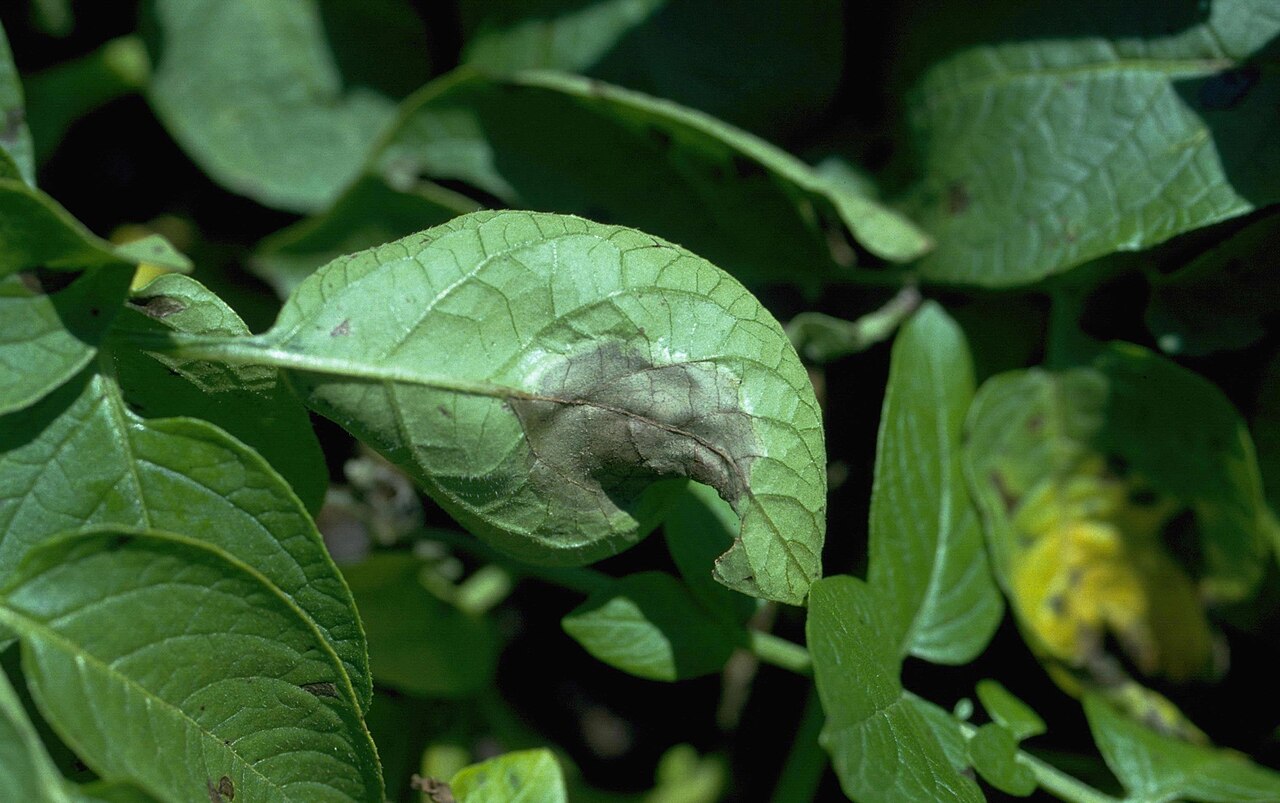
A potato leaflet showing late blight infection caused by Phytophthora infestans on a potato field at Peckham.
Howard F. Schwartz, Colorado State University, United States – http://www.forestryimages.org/browse/detail.cfm?
Late blight disease has a long and storied history in agriculture, dating back to the 19th century. The disease is believed to have originated in the Andean region of South America, where it co-evolved with wild Solanaceae species. It was first reported in Europe in the mid-1840s, where it quickly spread throughout the continent and devastated potato crops. The Irish potato famine of the 1840s, which resulted in the deaths of over a million people due to starvation and disease, was caused in large part by late blight disease.
In the years following the Irish potato famine, efforts were made to develop resistant potato varieties, but these efforts were largely unsuccessful. Continuing to cause widespread crop losses throughout Europe and North America, and the only effective control measures were based on copper-based fungicides, which were expensive and often ineffective.

In the early 20th century, a breakthrough occured when researchers discovered that wild Solanaceae species in South America exhibited resistance to late blight disease. This discovery led to the development of hybrid potato varieties that incorporated genes for disease resistance from these wild species. These new varieties, highly successful and became widely adopted by farmers around the world.

Kentaro Yoshida, Verena J Schuenemann, Liliana M Cano, Marina Pais, Bagdevi Mishra, Rahul Sharma, Chirsta Lanz, Frank N Martin, Sophien Kamoun, Johannes Krause, Marco Thines, Detlef Weigel, Hernán A Burbano – http://elifesciences.org/content/2/e00731
However, it continued to become a major problem in agriculture, particularly in regions with high levels of rainfall and humidity. In recent years, new strains of P. infestans have emerged that are more virulent and more difficult to control. In response, researchers are working to develop new varieties of potatoes and tomatoes with improved resistance to late blight disease, as well as new control measures that are more effective and sustainable.

Ronald Hutten, Laboratory of Plant breeding, Wageningen University – Dr. Henk Schouten
A photograph of diseased and cisgenic potatoes after exposure to potato blight (Phytophthora infestans). Taken during a field study in 2008.
In conclusion, a devastating plant disease that has had a profound impact on agriculture throughout history. Moreover, while progress has become made in developing resistant crop varieties, the disease continues to be a major challenge for farmers around the world. However, continued research and development efforts become necessary. Lastly, to ensure that this disease can become effectively controlled in the future.


