

What happens if interest rates are too high?
Dr. Campbell Harvey of Duke University’s esteemed Fuqua School of Business recently shared insights regarding the potential hazards the economy might face due to sustained high interest rates. We found the Professor’s arguments to be both insightful and compelling. And we wanted to share them with our readers:

The Implications of Rising Long Rates on the U.S. Economy: A Detailed Analysis
The U.S. economy faces significant headwinds from the sharp increase in long rates, which potentially introduce multifaceted risks that threaten to destabilize various sectors. This paper delves deeply into seven major risks associated with the upsurge in long rates, particularly emphasizing the burgeoning debt service burden and its repercussions on federal expenditures. Moreover, this paper examines the broader economic impacts that may ripple across the financial sector, commercial enterprises, and individual consumers.
1. The Burgeoning Debt Service Challenge
The rapid rise in long rates significantly exacerbates the debt service predicament of the federal government. The average interest rate on Federal debt stands at 2.8%, a figure poised to escalate. The current debt service approximates $620 billion. This can become elucidated by examining the total Federal debt. Which amounts to $32.3 trillion. Thus, by excluding agency debt, we focus on the debt held by the “public”, approximately $25.5 trillion. Given the Federal Reserve’s unique position in rebating interest to the Treasury, their holdings are subtracted, resulting in a net debt of around $22 trillion, which is equivalent to 69.4% of the GDP.
Moreover, a staggering 22% of tax receipts are designated for interest. Consequently, within a year, interest service expenses are projected to outstrip critical expenditure categories like health and national defense. Relying on borrowing to meet interest obligations has historically proven detrimental, further compounded by the exclusion of other unfunded government obligations from the $32.3 trillion debt figure.
2. Financial Sector Instability
The surge in long rates poses significant threats to bank balance sheets. Locked into extended-term loans and treasuries, banks face potential valuation collapses when long rates ascend. An illustrative example is the predicament of mortgage holdings. From July 2020, for over a year, the 30-year mortgage rates lingered below 3%. Contrasting this with the present rate of 7.3% reveals a more than twofold increase, elucidating the magnitude of duration risk. This risk notably led to the downfall of Silicon Valley Bank due to its exposure to longer duration Treasury bonds.
3. The Credit Squeeze Conundrum
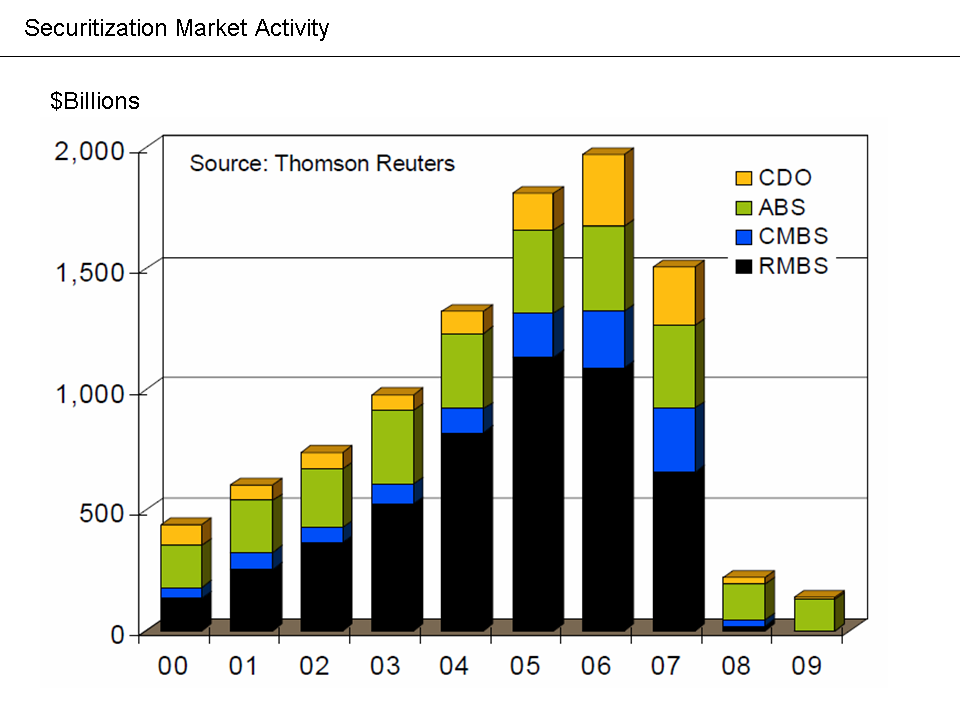
Securitization markets were impaired during the crisis. This shows how readily available credit dried-up during the 2007-2008 crisis. Farcaster (talk) 04:36, 10 October 2010 (UTC) – http://www.fcic.gov/hearings/pdfs/2010-0113-
The nexus of an inverted yield curve affecting bank profitability and soaring long rates compromising bank balance sheets results in a peculiar predicament. Banks find themselves capable of offering mere basis points on savings deposits, instigating a capital exodus to money market mutual funds (MMMFs) that typically invest in treasuries and analogous secure assets. This gradual transition effectively drains credit from the system, stifling economic growth.
4. The Investment Deficit
The escalating rates invariably amplify the capital cost, rendering numerous investment initiatives nonviable. With investment spending already in the negative realm, its pivotal role in driving GDP is severely compromised.
5. Consumer Financial Strain
Post-COVID savings, a significant GDP growth contributor in 2023, are anticipated to be exhausted by the year’s end. As many consumers grapple with dwindling savings, there’s a discernible uptick in credit card debt, indicating that relying on consumer spending as an economic bailout in 2024 might be unrealistic.
6. Commercial Real Estate Vulnerabilities
Soaring vacancy rates, with San Francisco at 32% and Chicago nearing a historical 20%, underscore the commercial real estate sector’s fragility. Given that banks hold considerable real estate debt, their preference to transition to higher rate loans might be stymied.
7. The Student Loan Repercussion
With over 40 million individuals burdened with student loans, the cessation of the COVID-era payment hiatus introduces further financial strain. The ongoing credit squeeze and escalating rates diminish loan affordability, complicating the replacement credit acquisition.
Conclusion
The sharp rise in long rates poses multifarious risks to the U.S. economy. By understanding these implications in their entirety, policymakers and stakeholders can devise strategic interventions to mitigate potential economic disruptions. Lastly, the need for prudent fiscal policies, robust financial sector regulations, and consumer-centric initiatives becomes paramount to navigate the complexities introduced by these rising rates.
https://www.linkedin.com/in/camharvey

The Levine Science Research Center is the largest single-site interdisciplinary research facility of any American university!


