

What happened to HMS Iron Duke?

Battleship HMS Iron Duke leads HMS Marlborough and other dreadnoughts of the Grand Fleet during World War One.
Building and Design of HMS Iron Duke
HMS Iron Duke is a notable ship in the history of the Royal Navy, particularly recognized for her role in World War I. Launched in 1912 and commissioned in 1914, she was the lead ship of her class of dreadnought battleships. Her design and construction were a part of the naval arms race that occurred in the early 20th century, primarily between Britain and Germany.

More details. A Destroyer alongside H.M.S. “Iron Duke”
The construction of the battleship later named Iron Duke commenced on January 15, 1912, at the Portsmouth Royal Dockyard.

Portsmouth Royal Dockyard’s Boathouse No 7 (built as a Mast House in 1807): Dockyard Apprentice exhibition (together with café and shops)
The ceremonial laying of the first keel-plate was performed by Miss Evelyn Moore, the sister of the then Commander-in-Chief at Portsmouth, Sir Arthur W. Moore. The event was attended by notable figures including Rear-Admiral Alban G. Tate, the Admiral Superintendent, and his wife, Mr. J. Apsey, who managed the Constructive Department, along with his wife, and Captain William B. Fawckner, the Captain of the Dockyard, accompanied by Mrs. Fawckner, among other officials.
The launching of the ship took place on October 12 in a grand ceremony witnessed by over 60,000 spectators on a bright Saturday. The Duchess of Wellington had the honor of naming the ship during this ceremony. In addition, the event also witnessed the presence of the new Admiral Superintendent Herbert L. Heath, along with his family, and a host of other naval and civil dignitaries.

More details. Sir Herbert Leopold Heath in 1916
The machinery for Iron Duke became supplied by the renowned firm Cammell, Laird & Co.
Design Features

HMS Iron Duke off Dover
- Armament: Iron Duke was armed with a main battery of ten 13.5-inch (343 mm) guns and an array of secondary armaments that included smaller caliber guns and torpedoes.
- Armor: She featured significant advancements in armor protection compared to her predecessors, with extensive armor plating on the hull and critical areas.
- Speed and Machinery: Powered by steam turbines, driving four propeller shafts, which gave her a high top speed for the era, around 21 to 22 knots.
History of HMS Iron Duke
designated as the flagship of the Home Fleets under Admiral Sir George A. Callaghan. She succeeded HMS Neptune in this prestigious role, with Neptune subsequently joining the First Battle Squadron.
Shortly after her commissioning, on March 18, 1914, Iron Duke experienced a minor mishap. The oiler Rosalind, caught in adverse conditions, collided with Iron Duke. This incident resulted in some structural damage to the battleship, including bent awning stanchions and several damaged scuttles. The repair costs for the damages incurred were modest, amounting to approximately £10, a small sum considering the magnitude and value of the vessel.
Early Years and World War I

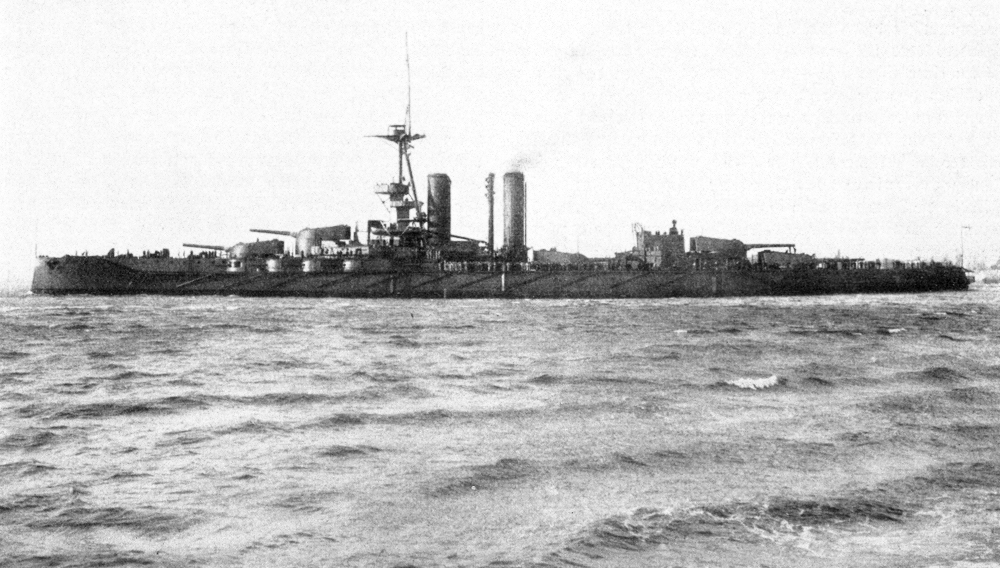
Battleship HMS Iron Duke Photographed by Ernest Hopkins of Southsea The Royal Navy in the First World War
- Commissioning and Role: HMS Iron Duke served as the flagship of the Grand Fleet for a significant part of World War I, under the command of Admiral Sir John Jellicoe.
- Battle of Jutland: Her most notable action was at the Battle of Jutland in 1916, the largest naval battle of the war. Iron Duke played a central role in the battle, leading the British line and engaging in several exchanges with the German High Seas Fleet.

Admiral Jellicoe’s flagship HMS Iron Duke with escorting destroyers leading the Grand Fleet into action at Jutland, 31st May, 1916

Charles Edward Dixon – Admiral Jellicoe’s flagship, H.M.S. Iron Duke, with the 2nd Battle Squadron at the Battle of Jutland. Charles Dixon – https://www.sothebys.com/en/auctions/ecatalogue/2005/marine-paintings-l05135/lot.53.html
Post World War I
- Interwar Period: After the war, Iron Duke continued to serve in the Royal Navy, though with the advent of newer and more advanced ships, her role became less central. She underwent several refits and modifications during this period.
- Training Ship: In the 1930s, she became converted into a training ship. Moreover, a role she fulfilled until the outbreak of World War II.
World War II and Later Years
- World War II: During the Second World War, Iron Duke was initially used as a depot and training ship. However, in 1939, she was severely damaged by German air raids and was thereafter relegated to use as a floating anti-aircraft battery.
- Decommissioning and Fate: After the war, Iron Duke was decommissioned and sold for scrap in 1946. Her dismantling marked the end of her over three decades of service in the Royal Navy.


More details. Barrel made from the teak of HMS Iron Duke.

More details. The Iron Duke leading other capital ships of the fleet. Previously described as HMS Queen Elizabeth leading other capital ships of the fleet in the catalogue signed and dated ‘Charles Dixon/1915’ (lower left) Lot number: /25338/lot/123/ The Marine Sale 29 Oct 2019. Charles Dixon – https://www.bonhams.com/auctions/25338/lot/123/
In conclusion, HMS Iron Duke’s service spanned two world wars, reflecting the significant transitions in naval warfare during the first half of the 20th century. Her design, armament, and armor represented the pinnacle of dreadnought battleship development at the time of her commissioning, and her history is a testament to the changing nature of naval power and technology in the early 20th century.
Lastly, the ship’s legacy lives on as a symbol of the era’s naval strategy and the broader historical context of the time.


