

University of Houston Dean & Globally Renowned Scientist Dr. Paul A. Pavlou
Rebellion Research: Dr. Pavlou, thank you for joining us today. Dr. Paul Pavlou is the Dean of the C. T. Bauer College of Business at the University of Houston. Among his many accomplishments, he was ranked #1 in publications by the top two information science journals, MISQ & ISR, and is a Distinguished Fellow of the INFORMS Information Systems Society. His work has been cited over 90,000 times on Google Scholar, and he was recognized as one of the “World’s Most Influential Scientific Minds” by Thomson Reuters.
Dr. Paul Pavlou: It is a great pleasure to meet you, Avhan. You have an impressive background. I am looking forward to our conversation today.
Rebellion Research: I’d like to start from the beginning of your academic journey. You studied Electrical Engineering before earning a PhD in Business Administration from USC. One of your earliest listed publications, dating back to 2002, was a study on consumer behavior in electronic markets. What sparked your interest in markets and information systems as an electrical engineer?
Dr. Paul Pavlou: Absolutely, yes. That’s a very good question. I’m glad you found the paper from a while back. I’ve always been fascinated by technology and how it changes society, civilization, and individual behavior. In the late 1990s, it was an intriguing period with the emergence of the internet and the proliferation of electronic commerce, such as eBay and Amazon. I found the entire concept captivating, particularly the idea of conducting business using technology and the internet, and how this virtual medium transforms transactions.
During that time, regulations were not as strict and developed as they are now. People were apprehensive about conducting transactions online, entering their credit card information, and uncertain about the outcome. This led me to question: how can we make this medium more accessible to the general public? The core of that initial study was building trust in electronic commerce.
We wondered how to leverage reviews to establish an online reputation. Today, we commonly see this in the form of five-star rating systems, but back then, the concept was not well-defined or understood. As an engineer, I find these novel ways in which technology changes people’s behavior quite fascinating.
Rebellion Research: I think that’s actually a perfect segue into my next question. You touched on this a bit, but could you please describe the state of the field of information systems and management science at that time? More specifically, did institutions offer dedicated programs, and if so, how did those programs compare to today’s offerings?
Dr. Paul Pavlou: Certainly. The field of information systems is relatively new. In the late 1970s and early 1980s, there were large IBM computers, but then consumer computers gained prominence, primarily within organizations and businesses. This marked the early stages when individuals could afford basic computers. So, the field is quite young in comparison to management and, especially, science.
I was drawn to the field of information systems because it explores technology’s impact on society, businesses, and civilization as a whole. From early-stage computers to powerful AI technologies, blockchain, and the Internet of Things, the field examines how technology shapes various facets of
society. Our conversation began with a discussion of the emergence of the internet and electronic markets in the 1990s, and now, in 2023, we can look back and appreciate the field’s continuous evolution.
Rebellion Research: I can certainly attest to this evolution in information science research. Such work has gained momentum over the past several years, based on the papers I’ve been reading. I’d like to highlight one of your papers that I recently read: “Understanding the Elusive Black Box of Dynamic Capabilities” from 2011, which ranked #8 in the most downloaded papers as of 2021. Here, you propose a model to measure dynamic capabilities, and you also address the open question of optimizing for dynamic capabilities versus operational capabilities. Given your more recent experiences in executive positions, how would you assess the trade-off between dynamic capabilities and operational efficiencies? Have your views from 2011 evolved, or have your management experiences influenced your perspective?
Dr. Paul Pavlou: Excellent question. Thank you for reading my work, Avhan. In fact, this paper originated from my doctoral dissertation at USC. It delved into how technologies aid organizations in developing dynamic capabilities. I should mention that, at that time, the concept of dynamic capabilities for organizations was not widely comprehended. The paper was an attempt to understand the term “dynamic capabilities,” devise ways to measure them, and explore their applications.
Dynamic capabilities and operational capabilities must collaborate, particularly to address the ever-evolving needs of businesses. However, these two aspects are not inherently complementary; in fact, they can sometimes compete with each other. Take, for example, the COVID-19 pandemic, which forced organizations across the board to adapt. Traditionally, our university conducted in-person teaching, but we had to swiftly transition to online teaching—a non-trivial task. This required developing dynamic capabilities to navigate the new environment and the rapid changes brought about by the pandemic.
Numerous organizations demonstrated similar adaptability after the onset of the pandemic. The ability to comprehend and adjust to a changing landscape is crucial.
Rebellion Research: You’ve explored a wide range of topics, from Bayesian networks and market behavior to intelligent transportation, crowdfunding, and even social media studies. This highlights the interdisciplinary nature of the field. Why do you believe it’s essential to address social science issues through a technological lens? Are there any limitations to the scope of questions that information science can address?
Dr. Paul Pavlou: One of the primary reasons I’m drawn to the field of information systems is its inherent interdisciplinary nature. While one could certainly focus solely on computer science or technology, I find this less captivating. I’m interested in how the application of technology can influence society. To explore this, multiple perspectives are required. Our earlier discussion on dynamic capabilities is an inherently
strategic phenomenon that organizations face. Before that, we spoke about the rise of electronic markets and how individuals utilize technology to feel comfortable with online transactions. Our current discussion about AI is even more interdisciplinary.
While there are remarkable individuals developing AI technology, my personal interest lies in understanding how AI transforms our day-to-day lives. For example, will students complete their own
assignments, or will they rely on Chat-GPT to do the work for them? Will traditional email writing become obsolete as we turn to the Google Lab generator for email creation? AI also significantly impacts financial markets, supply chains, and various other business realms.
Currently, we’re working on a study centered on consumers using AI to make decisions about purchasing clothes. Traditionally, we relied on salespeople to help us in the simple decision of what clothes to purchase. However, now we have advanced technologies intelligently guiding us based on factors such as appearance, body composition, and recent fashion trends. These recommendations might not align with our personal preferences or the advice of salespeople.
People want control over their decisions. Interestingly, our study reveals that if this AI is on our cell phones, we are more likely to trust it compared to if it were on an impersonal store computer. We tend to feel a sense of ownership and comfort with our cell phones. These nuances highlight how different stakeholders creatively adapt to and accept technology.
Rebellion Research: Much of our work at Rebellion Research revolves around artificial intelligence, both in practice and theory. From your position as a Dean, what insights can you offer regarding future careers in AI and management science?
Dr. Paul Pavlou: Great question. Honestly, I do not have an answer, but I can share my thoughts. Often, people believe their jobs are secure, but I always advise that no job is safe. While your position might not be replaced tomorrow, it could occur in the near future. Technological advancements enhance efficiency and effectiveness, and reduce the overall workforce required. Some projections suggest that by 2030, approximately half of the current job roles might cease to exist.
Technology profoundly alters society and the nature of work. I always recommend that students don’t oppose technology—you’ll always lose. Embrace technology instead. Try to use it effectively, try to understand it, and try to help use technology to make your jobs more effective. Most importantly, try to be at the forefront. Technology will change every profession one way or the other. Whether in finance, accounting, or supply chain management, staying well-versed in how your field is impacted by technology is crucial. Embrace and effectively leverage technology, or risk becoming obsolete.
Rebellion Research: I can certainly resonate with those sentiments based on my observations. You touched on some valuable pieces of advice that you share with your students. I imagine Bauer has adapted to incorporate more technical aspects to accommodate the growing application of artificial intelligence and technology within management science. Specifically, what academic opportunities are available for students at Bauer to explore the intersection of these fields?
Dr. Paul Pavlou: We have several initiatives to promote information science at Bauer. Our motto is “the future is our business.” We recognize that change is driven by technology, so we strive to remain at the forefront of these shifts, industry trends, and requirements. In the realm of information science, we offer a robust analytics program. Regarding artificial intelligence, we work with Intel to provide an AI in entrepreneurship certificate. These industry connections equip our students with the latest tools.
In terms of job prospects, we’re fortunate that nearly 100% of our graduates find placement in industry, particularly within the technical domain. Our graduating students consistently succeed in terms of both salary and career opportunities, and secure positions at top consulting firms, energy companies, technology companies. With an enrollment of 8000 students, we’re pleased that each one gains the latest skills and ample opportunities for practical application in the business world.
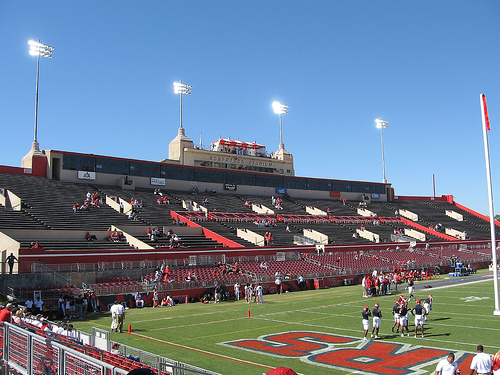
UH’s Robertson Stadium during a gameday.
Rebellion Research: Your track record of success is truly remarkable. Your insights underline the bright future of AI, bridging the gap between leaders and technologists. With that, we thank you, Dr. Pavlou, for taking time to share your thoughts. It is a privilege and an honor to engage with one of the foremost researchers in this field.
Dr. Paul Pavlou: I appreciate your insightful questions, Avhan. I really enjoyed this conversation. As you noted, we are living in an exciting time period with a promising future for technology and information science. Remember, embracing change and technology is a pathway to success.
Interview conducted by Avhan Misra, Cornell University College of Engineering
Amherst College Dean talks with Rebellion Research
Babson College President talks with Rebellion Research
Barnard College President talks with Rebellion Research
Berkeley Dean talks with Rebellion Research
Dartmouth College President talks with Rebellion Research
Harvard Business School Executive Director talks with Rebellion Research
Harvard Law School Dean talks with Rebellion Research
MIT Board Member Talks With Rebellion Research
MIT Professor & Physics Nobel Prize Winner Talks With Rebellion Research
Stanford Professor & Nobel Prize Winner Talks With Rebellion Research
Pulitzer Prize Winner & Columbia University Professor talks with Rebellion Research
Wellesly College Professor talks with Rebellion Research
Johns Hopkins Professor talks with Rebellion Research
Wharton Professor talks with Rebellion Research


