

The Slow Death of Aoba

Aoba, photographed off Buin, Bougainville after the Battle of Cape Esperance.
Named for Mount Aoba, a volcano located behind Kyoto.
Colored according to elevation. Elevation data acquired by the Shuttle Radar Topography Mission on 2000-02-11 aboard Endeavour shuttle.
Aoba was constructed at Mitsubishi’s Nagasaki shipyards, being launched on 20 September 1927. Initially assigned to Cruiser Division 5 (CruDiv5) until 1933, it later served in Cruiser Divisions 6 and 7 (CruDiv6 and CruDiv7), often as the flagship.
In 1924, the Japanese Imperial Navy’s Naval General Staff urged Kikuo Fujimoto, who was leading the Basic Design Section at the time, to incorporate the innovative twin 20 cm (7.9 in) “Type C” gun turrets into the design of the Furutaka-class ships. Fujimoto consented to this change for the Aoba and Kinugasa, but retrofitting the Furutaka and Kako, which had begun construction in late 1922, was not feasible at that stage. As a result, Aoba and Kinugasa were reclassified into a distinct class.

Heavy cruiser Furutaka
Nonetheless, Furutaka and Kako eventually received twin turrets as well, undergoing an upgrade in 1937 that included the installation of 203mm main guns, aligning them with their class counterparts.

Panoramic view of Sasebo Naval Arsenal (c1920-1930).
Throughout the late 1920s and 1930s, Aoba was regularly deployed for patrols along the coast of China. A significant modernization took place at Sasebo Navy Yard from 1938 to 1940. This refit included the installation of new torpedo launchers, enhanced anti-aircraft weaponry, advanced fire control systems, and improved aircraft handling capabilities.

World War II recognition drawings of Aoba
Office of Naval Intelligence – http://www.history.navy.mil/photos/images/h97000/h97733c.htm
Eventually the cruiser’s bridge was redesigned and hull bulges were added to address the issues of extra weight and stability. Following these upgrades, Aoba was recommissioned in October 1940 and rejoined CruDiv6.

Japanese heavy cruiser Aoba soon after commissioning.
During the initial phase of the Pacific War in 1941, the cruiser Aoba, under the command of Rear Admiral Aritomo Goto, served as the flagship of Cruiser Division 6 (CruDiv 6), which was part of the First Fleet led by Vice Admiral Takasu Shiro. This division, comprising Aoba, Kinugasa, Furutaka, and Kako, was actively involved in the Guam invasion during the Pearl Harbor attack and later took part in the second assault on Wake Island.
At the Coral Sea battle, CruDiv 6 left Shortland and joined up with the light aircraft carrier Shōhō at sea. On May 7, 1942, north of Taguli Island, Shōhō was sunk by a combined assault from 93 SBD Dauntless dive bombers and TBD Devastator torpedo bombers from the USS Yorktown and Lexington.

Detonation of a 1,000-pound (450 kg) bomb on Shōhō during the Battle of the Coral Sea.
The next day, May 8, aircraft from Yorktown and Lexington inflicted severe damage to the carrier Shōkaku, forcing it to withdraw. While Furutaka and Kinugasa, unharmed in the conflict, escorted Shōkaku back to Truk, Kako and Aoba provided cover for the retreating Port Moresby invasion convoy.
After refueling at Shortland on May 9, Aoba proceeded to Kure Naval Arsenal for repairs on May 22, returning to Truk on June 23. Aoba then moved to Rekata Bay, Santa Isabel Island, for patrols in July.

Kure Naval Arsenal panorama, 1945
On July 14, 1942, a significant reorganization of the Japanese navy reassigned Aoba to the newly formed Eighth Fleet, led by Vice Admiral Mikawa Gunichi, for patrols around the Solomon Islands, New Britain, and New Ireland.
During the Savo Island battle on August 9, 1942, Aoba, along with CruDiv 6, Chōkai, and other Japanese ships, engaged an Allied force in a nocturnal gun and torpedo attack.
The Allies lost several ships, including the cruisers USS Astoria, Quincy, Vincennes, and HMAS Canberra, while the Japanese suffered minor damages. CruDiv 6, however, lost Kako to the submarine USS S-44, while Aoba evaded further harm. In the ensuing months, Aoba and CruDiv 6 supported the “Tokyo Express” convoys to Guadalcanal.

Destroyers removing crew from HMAS Canberra after the Battle of Savo Island, 9 August 1942. USS Blue is alongside Canberra‘s port bow, as USS Patterson approaches from astern.
During the Cape Esperance battle on October 11, 1942, CruDiv 6, accompanied by destroyers Fubuki and Hatsuyuki, left Shortland to cover a troop convoy by attacking Henderson Field on Guadalcanal. Spotted by American reconnaissance, the radar-equipped U.S. cruisers USS San Francisco, Boise, Salt Lake City, and Helena, along with five destroyers, intercepted the Japanese.
Aoba at Esperance
At 2235, Helena detected the Japanese fleet, leading to a fierce engagement. Admiral Goto, mistakenly believing he was under friendly fire, ordered a retreat, which led to significant damage to his ships. Furutaka sank, and Aoba sustained heavy damage, losing Admiral Goto and 80 crew members. After temporary repairs at Shortland, Aoba retreated to Truk on October 15, where Admiral Isoroku Yamamoto inspected the damage and ordered the ship’s return to Japan.
Aoba arrived back in Kure on October 22 for repairs. During this period, the damaged No. 3 turret was sealed with steel plating, and a Type 96 triple-mount 25-mm anti-aircraft gun was installed in its place. The ship was then redeployed to Truk on February 24, 1943.
On April 3, while docked at Kavieng, New Ireland, Aoba was targeted by Boeing B-17 Flying Fortresses from the 43rd Bombardment Group of the Fifth Air Force. A direct bomb strike led to the detonation of two Type 93 Long Lance torpedoes onboard, causing a significant fire. The ship was subsequently beached to prevent it from sinking.

B-17’s bombing above the clouds.
Later, Aoba was towed first back to Truk and then to Kure, arriving on August 1. Repairs and upgrades were undertaken, including the restoration of the 200 mm gun in the No. 3 turret, the addition of a Type 21 air-search radar, and two Type 96 twin-mount 25-mm AA guns. However, damage to the engines was beyond full repair, limiting Aoba’s top speed to 25 knots (46 km/h).
Reassigned to the First Southern Expeditionary Fleet, Aoba reached Singapore on December 24, 1943. The ship operated out of Singapore until the end of February 1944, tasked with escorting supply convoys to Burma, the Andaman Islands, and along the Malayan coastline. On February 25, Aoba was transferred to Cruiser Division 16 (CruDiv16) and took part in the Indian Ocean raid in March 1944. From April to June, the cruiser continued its escort duties in the Dutch East Indies and New Guinea. During a refit in Singapore in July, Aoba was equipped with four triple-mount and 15 single-mount Type 96 25-mm AA guns, and a Type 22 surface-search radar.
Beginning of the End
On the 11th of October, Aoba inadvertently collided with the cruiser Kinu.
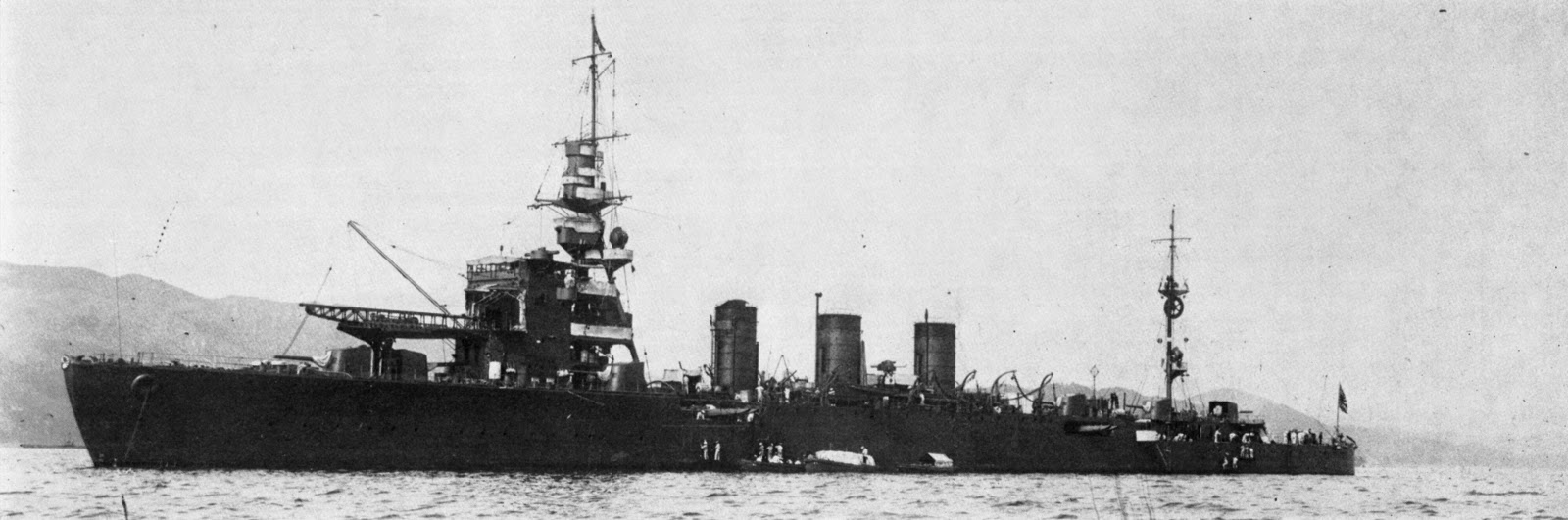
Japanese light cruiser Kinu off Kyushu in 1931. Mikasa Memorial Museum
The impact resulted in only minor damage to both vessels. However, the situation escalated on October 23, 1944, when Aoba found itself under attack from the submarine USS Bream. During this engagement, Aoba sustained a direct torpedo hit to its No. 2 engine room. Inflicted by one of the six torpedoes launched by Bream. This critical hit forced Aoba to navigate with difficulty to the Cavite Navy Yard near Manila for urgent repairs.

USS Bream
As Aoba underwent emergency repair work on the following day and again on October 29, it became the target of carrier-based aircraft from Task Force 38.
These air raids occurred while the ship was still docked and in a vulnerable state, with repairs far from completion. Despite the ongoing repair efforts, Aoba was soon assigned to a convoy designated to return to Japan. This convoy, however, did not have an uneventful journey.
On November 6, while the convoy was navigating off Luzon, it was ambushed by a group of submarines, including the USS Guitarro, Bream, Raton, and Ray. The submarines launched a total of 23 torpedoes during this attack. Among these, two torpedoes struck the cruiser Kumano. Remarkably, Aoba managed to avoid any further damage during this intense encounter.
Upon reaching Kure on December 12, a thorough inspection of Aoba was conducted. However, the assessment concluded that the ship was beyond repair.
As a result, Aoba became demoted from its active status and reclassified as a reserve ship. The series of events leading up to this point marked a significant and final chapter in Aoba’s service history.
Continued Allied Bombing Attacks
During an American air strike on Kure harbor on April 24, 1945, Aoba sustained additional damage from bombings, causing it to sink partially and rest on the harbor’s shallow floor. Instead of attempting to repair the severely damaged vessel, the decision was made to reinforce its defensive capabilities. To this end, four more twin 25-mm anti-aircraft guns were installed near the mainmast. This upgrade increased Aoba’s total anti-aircraft arsenal to 50 barrels, including a combination of triple, double, and single-mounted 25-mm guns. Consequently, Aoba’s role was shifted to serve as a stationary anti-aircraft platform.
The situation worsened on July 24, 1945, when around 30 aircraft from Task Force 38 launched another attack on Kure, targeting Aoba once again. As a result of this intense bombing, at 2200 hours, the ship sank further. Settling at the bottom of the harbor in approximately 25 feet (7.6 meters) of water, located at the coordinates 34°14’N 132°30’E.

15th Air Force B-24s fly through flak and over the destruction created by preceding waves of bombers.
The attacks on Aoba didn’t cease there. On July 28, 1945, the ship’s remains were bombarded yet again, this time by ten aircraft from Task Force 38’s carrier group. This assault inflicted more direct hits, leading to a fire on the ship. The blaze drew the attention of the 7th Air Force’s B-24 Liberator bombers, which further escalated the attack by dropping four additional 500-pound (230 kg) bombs on the hulk. This final bombardment resulted in the stern breaking off, marking a grim conclusion to the once formidable cruiser’s service.
Aoba was formally removed from the Navy List on 20 November 1945.

Aoba settled on the bottom of shallow Kure harbor at end of World War II


