


Stalin’s Battleship Dreams The design of Stalin’s dream battleships look a great deal like the U.S. Iowa Class battleship.
Of course, after WWII and the losses of the Yamato and Musashi to dive bombers. It should have been obvious even to Stalin that the era of the battleship was over.
It was now the age of the aircraft carrier and the submarine.
That being said, the Soviets did a great deal of “puffing” to make their military technology appear far more efficient and menacing than it really was. Khrushchev spoke about ICBM production as “running off assembly lines like sausages.”
The Soviet’s early missile-firing submarines were accidents waiting to happen. And even the 100 megaton Tsar bomb (tested at 57 megatons) was a totally impractical weapon (maybe good for blowing up an asteroid).
Another good example of this is the MiG-25, what was assumed to be a “super plane” by the West. But, it turned out to be a very conventional airframe with very, very large engines that gave it a brief top speed of Mach 3.2. It was a very fast, unmanageable brick totally unsuited for air combat.
NASA Astronaut Norm Thagard, who flew on a Soyuz and spent several months on the MIR space station. Said, “Russian technology looked more like ours from the 1960s.”
The following “Soviet Intelligence Document” was published more as a curiosity piece in Jane’s:

Joseph Stalin had some profound ambitions for the Soviet Union to build a “Blue Water Navy.”
But, his plans were delayed by the German invasion (1941-45).
See our piece on the German invasion of Russia: Operation Barbarossa
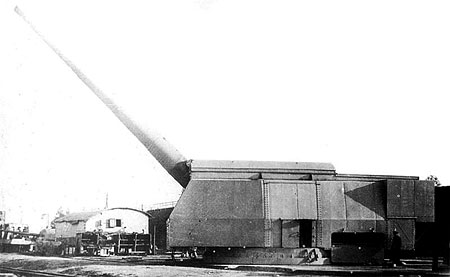
Unknown author – http://www.nimap.spb.ru/index.php?ru&pp_guns_mp10

After World War II he restarted rebuilding the Soviet Red Navy, but ran into problems of building large heavy units. Since most of the shipyards in Western Soviet Union were damaged by the war. As a result, construction programs were slowed in the making, except for building smaller naval units; such as destroyers and submarines.
From 1948 to 1953 the Soviet Union was engaged in a proactive intelligence deception project against the Western nation-states.
False reports were stating heavy units or guided missile battleships were being built in Siberian shipyards.
Some of these reports were found in Soviet publications, then later found their way in Western publications. These false reports were circulated around the world, with possible names for these battleships; Strana Sovietov, Sovietskaya Byelorossiya, Sovietskaya Konstitutzia, Krassnaya Bessarabya, Krassnaya Sibirya, Lenin and also Sovietskiy Soyuz.
The details about these battleships varied between 35,000 tons to 55,000 tons of displacement. The battleships’ armament was said to be six or nine 15.9 inch guns. With many medium range guns, with two domed turrets for launching missiles. The reports also stated these battleships could make 25 to 30 knots.
The Western publications were quite eager to print and disseminate all these false reports; although, the Soviets’ main purpose was to intimidate the West with superior warships.
Yet, the greatest achievement for this Soviets’ deception was when the Janes’ Fighting Ships 1949/1950 edition published the false reports, along with a drawing illustration.
Lastly, the Janes’ publication was the West’s premier reference for all warships in the world. And yet, none of these Soviet battleships ever existed.
Written by John B. Morgen
Future Of Russia’s Submarine Fleet
Russia’s Military : Can Russia Fund A Superpower’s Military?
How did the Submarine Kursk disaster occur? Who was to blame?
Worst Russian Military Aircraft Crash : 1981 Crash at Pushkin
Russian Aircraft Carrier Admiral Kuznetsov


