

Sinking Of French Battleship Suffren

French battleship Suffren off Toulon on 23 October 1911.
In the turbulent waters of World War I, the fate of the Armée Navale battleships in the Mediterranean became characterized by adversity and loss.
Moreover, this epoch was notably marked by the sinking of the French battleship Suffren. Highlighting the inherent vulnerabilities of naval vessels of the time and the ongoing evolution in naval warfare technology.
The Suffren had a storied history, even before its ultimate sinking.

Plan and right elevation from Brassey’s Naval Annual 1912.
Completed in 1902, she was an enlarged and improved version of the Iéna, an improved Charlemagne class design.

French battleship Iéna on her sea trials.
Surviving A Magazine Explosion
In 1907, it encountered a significant challenge – a magazine explosion onboard.
Yes, amazingly enough Suffren did what Hood could not, and that is survive an onboard magazine explosion.
For further reading: HMS Hood & Her Sinking By Bismarck

Conning tower detail
Against the odds, the ship and its crew managed to survive this incident. This event not only demonstrated the resilience of the Suffren but also marked it as one of the few vessels of the time to endure such a calamity and continue its service.
WW1

Illustration of Suffren off the Dardanelles in 1915 by Norman Wilkinson.
At the outset of the war Suffren would find herself assigned to naval operations off the Dardanelles, where she participated in a series of attacks on the Ottoman fortifications guarding the straits.

Photo capturing the last moments of the French battleship Bouvet which struck a mine in the Dardanelles on 18 March 1915, capsized and sank within two minutes, killing over 600 men. A caption in L’illustration sets the time of the image as 13:58 on 18 March 1915 and states that the photograph was taken from an English ship.
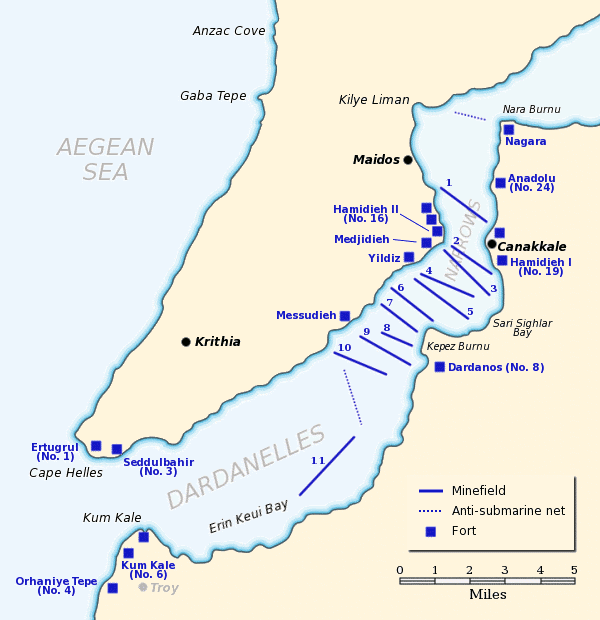
Map of the Dardanelles defences in February and March, 1915. The original lines of naval mines are numbered 1 to 10. The 11th line, laid in Erin Keui Bay by the minelayer Nusrat on 8 March, is numbered 11. The anti-submarine nets are shown as dotted lines. Major forts are indicated with blue boxes and the Turkish name and equivalent British number for the fort is given, if known.

Illustration of Suffren shelling Ottoman positions.
However, the trials for Suffren were far from over.
On 26th November 1916, tragedy struck when the battleship was torpedoed by SM U-52 off the Portuguese coast. This attack led to a catastrophic loss, with all 648 sailors on board perishing, leaving no survivors or recoverable bodies, only the scattered debris of the once-majestic vessel marking the grim aftermath.
This sinking was not an isolated incident; it was part of a series of misfortunes that befell the Armée Navale battleships during that period.

The Gaulois succumbed to a similar fate a month later, and in March 1917, the Danton was struck by two torpedoes from U-64 and sank southwest of Sardinia. These incidents underscored the pressing vulnerabilities of the vessels and the continuous threats posed by German U-boats.
French naval design during this era became characterized by a hesitation to adopt the evolving Dreadnought technology, a standard set by the British. This reluctance stemmed from a sense of national pride and a desire to maintain a distinct naval identity. Consequently, the French Navy produced an array of ships with varied capabilities and designs, which illustrated the challenges in balancing tradition and innovation.
The reluctance to adapt quickly to newer technologies meant that the French Navy had to confront the evolving threats with a fleet that exhibited a mix of resilience and vulnerability.
The sinking of Suffren and its counterparts highlighted the need for advancements in naval design, technology, and crew training, prompting a reevaluation of naval strategy and adaptation to emerging maritime challenges.
Reflecting on the history of the Suffren provides a deeper understanding of the complexities and dynamics of naval warfare during World War I. The ship’s resilience, the crew’s sacrifices, and the eventual tragedy that befell it are emblematic of the broader challenges faced by naval vessels of the First World War. The Suffren’s story is a testament to the enduring interplay between national pride, technological advancement, and the imperative for adaptation in an ever-evolving naval warfare landscape.


