

Mathematically Forecasting Stock Prices with Geometric Brownian Motion
Review of “Mathematically Forecasting Stock Prices with Geometric Brownian Motion” by Anay Kumar, Isa Jamadar, Radhika Goel, Ram Charan Petluri, and Wei Feng

An example of absorption lines in a spectrum.
Exploring the application of Geometric Brownian Motion (GBM) to forecast stock prices while offering a nuanced approach to modeling market volatility. The authors analyze and adapt the Reddy-Clinton equation, incorporating stochastic elements to reflect the unpredictable nature of stock markets.

Reproduced from the book of Jean Baptiste Perrin, Les Atomes, three tracings of the motion of colloidal particles of radius 0.53 µm, as seen under the microscope, are displayed. Successive positions every 30 seconds are joined by straight line segments (the mesh size is 3.2 µm).
Key Concepts and Methodology

The characteristic bell-shaped curves of the diffusion of Brownian particles. The distribution begins as a Dirac delta function, indicating that all the particles are located at the origin at time t = 0. As t increases, the distribution flattens (though remains bell-shaped), and ultimately becomes uniform in the limit that time goes to infinity.
- Reddy-Clinton Equation: The paper focuses on this specific equation, which combines deterministic and stochastic components to model stock price movements.
- Adjustment of Stochastic Variable (ϵ): A significant contribution of this paper is the adjustment of the ϵ value, representing stochasticity, through an adapted bell-curve model to enhance accuracy.
- Application to Diverse Stocks: The adapted model became tested on stocks from various sectors (AAPL, OXY, PYPL, MCD, and SPG). As a result, demonstrating its applicability across different market conditions.
Results and Accuracy

“A sketch of Perrin’s results of a microscopic examination of the equilibrium. Or barometric distribution of granules of gamboge, which is a sticky substance used as a bright yellow water color. The granules are approximately uniform in diameter (0.6 microns). The relative change in density observed in 10 microns of suspension is equivalent to that occurring in 6 km of air or a magnification of 600 000 000.”
- Mean Absolute Percentage Error (MAPE): The model achieved a MAPE of 6.87% over six months, indicating high accuracy in forecasting stock prices.
- Handling Real-World Volatility: Despite challenges posed by real-world occurrences, the model effectively accounted for random volatility, improving the coherence of the predictions with actual market trends.
Strengths of the Study

Various atoms and molecules as depicted in John Dalton‘s A New System of Chemical Philosophy (1808). haade – En.wiki (https://archive.org/details/newsystemofchemi01daltuoft/page/n237)
- Enhanced Volatility Modeling: The paper’s approach to adjusting the calculation of ϵ results in a more precise forecast, better capturing market volatility.
- Iterative Approach for Accuracy: Employing multiple iterations and averaging the results helped eliminate randomness and enhance the consistency of the model.
Limitations and Future Research
- Dependency on Historical Data: The model’s accuracy diminishes over time as it operates independently of real-world data. Periodic recalibration with new data is necessary.
- Transition to Company-Specific Lognormal Distribution: For future research, the authors suggest transitioning from a normal distribution curve to a company-specific lognormal distribution curve to better align the model with company trends.
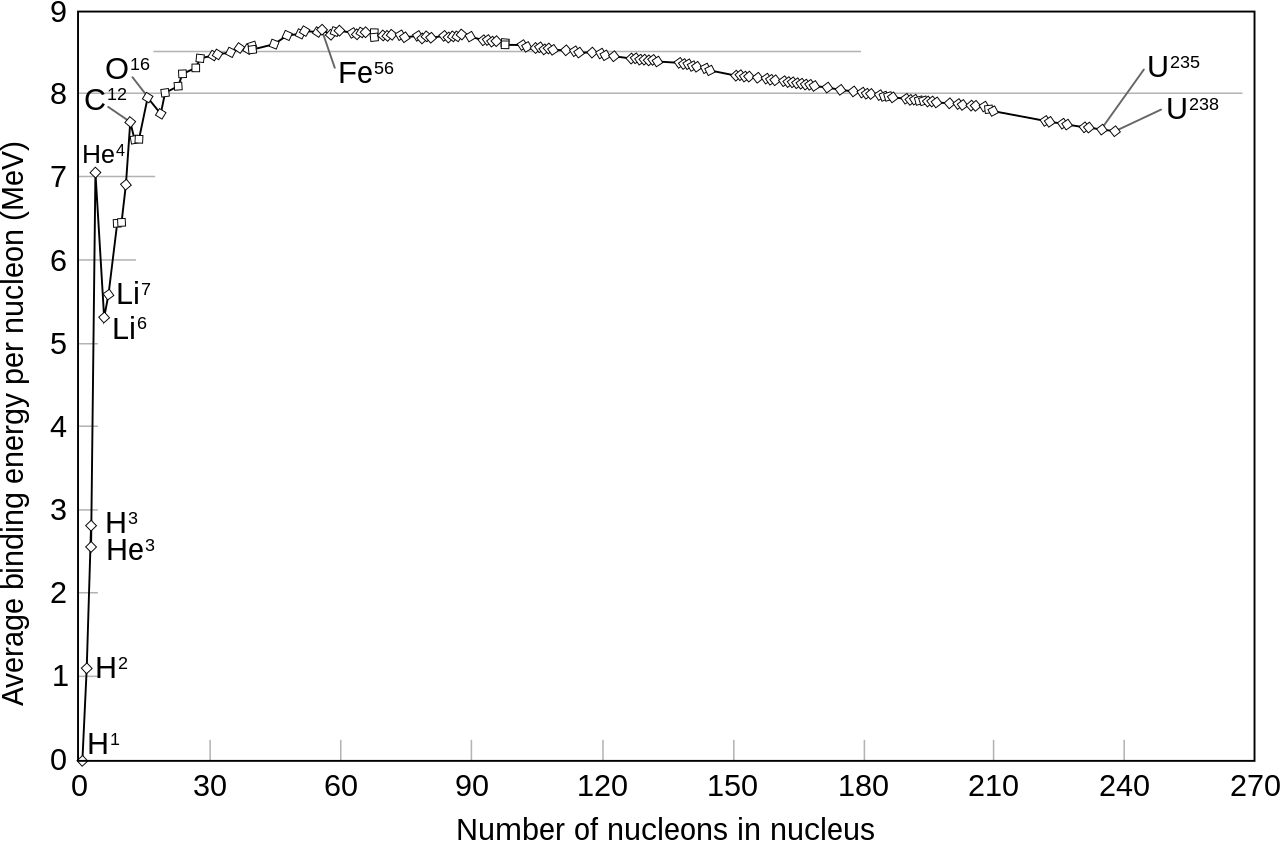
The binding energy needed for a nucleon to escape the nucleus, for various isotopes.
In conclusion, “Mathematically Forecasting Stock Prices with Geometric Brownian Motion” presents a sophisticated and practical approach to stock market forecasting. The paper stands out for its innovative adaptation of the Reddy-Clinton equation and its effective handling of market volatility. While facing challenges in real-world application, the model shows considerable promise and sets a direction for future research in financial modeling.


