

Is Sherman a bad tank?
The M4 Sherman Tank: The Harsh Reality Inside the Steel Behemoth

Kwajalein Atoll.

Bougainville, 1944

House to house fighting with the Germans at Riva Bella, near Ouistreham. Sherman DD tanks are providing fire support and cover. 6 June 1944.
The M4 Sherman, an emblematic armored vehicle of the United States during World War II, was paradoxically both a beacon of hope and a potential death trap for its crew. While it became the primary tank for almost all Allied countries (Russia being the exception), its widespread usage was more due to its mass production capabilities rather than any inherent superiority in design.
Henry J. Earl, a former Sherman operator, provides a poignant glimpse into the perils of manning such a vehicle. In a 1983 letter addressed to Lt. Colonel Haynes Dugan, a G-2 intelligence officer for the 3rd Armored Division, Earl recounted a harrowing experience: “The hit was low on the side. The interior of the tank was lit by a ball of fire… A white hot eighteen-pound projectile entered the empty ammunition rack under the floor… This saved the crew.” This narrative starkly contrasts with the fate of many other Sherman operators who weren’t as fortunate.

Canadian crew of a Sherman-tank south of Vaucelles, June 1944.
In their first combat test in North Africa in 1942, the Shermans held their own against the Panzer IV, Germany’s mainstay.
This initial success, however, may have contributed to overconfidence. When deployed in Normandy and throughout Europe, the Sherman’s vulnerabilities became painfully clear. Belton Cooper’s book “Death Traps” crystallizes this, revealing a staggering statistic: “The 3rd Armored Division entered combat in Normandy with 232 M4 Sherman tanks. During the European Campaign, the Division had some 648 Sherman tanks completely destroyed in combat and another 700 knocked out, repaired, and put back into operation. This was a loss rate of 580 percent.”
The German Panzer IV was superior to the Sherman even before its upgrades in 1943. The Sherman paled in comparison, especially when faced with the formidable German Tiger and Panther tanks. Lt. Colonel William B. Lovelady, the commander of the 3rd Armored Division’s 2nd Battalion, highlighted this disparity with a chilling account. In a confrontation with a Panther tank, a Sherman managed to fire three shots — all of which failed to penetrate the Panther’s armor. In return, a single shot from the Panther, which penetrated two sides of a house and then the Sherman, rendered the American tank inoperable.
This lack of armor meant that Shermans were particularly susceptible to catching fire when hit.
To make matters worse, these fires often ignited the shells and munitions stored within, leading to catastrophic explosions. British troops darkly dubbed the Sherman tanks “Ronsons”, after a popular lighter brand whose tagline was, “Lights up the first time, every time!” Meanwhile, Polish soldiers gave them an even grimmer title: “The Burning Grave.”

Mired M4 Sherman tank on a Normandy invasion beach, 12 June 1944.
Efforts to mitigate the Sherman’s vulnerabilities were made throughout the war. Improved coordination tactics and enhanced ammunition storage systems became introduced. Additionally, armored divisions maintained efficient repair crews to address damage swiftly. While these measures helped, they couldn’t alter the fundamental design issues plaguing the tank.
Nevertheless, the sheer number of Shermans produced, combined with the speed of their manufacturing, became a strategic advantage. The tank’s abundance ensured its continuous deployment despite its flaws. The M4 Sherman was indeed riddled with issues and posed significant risks to its crew. Still, it played an indispensable role in the Allied Forces’ eventual triumph in WWII.
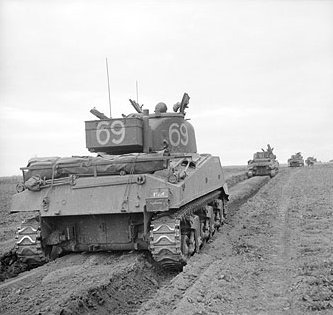
Sherman tanks during Operation ‘Charnwood’, the attack on Caen, 8 July 1944.
Is Sherman a bad tank? Is Sherman a bad tank?
A Poor Defense: Tanks in WW2 – University of Illinois Archives – U of I Library


