

How Was William Wallace Captured?

There is limited information available about William Wallace’s life before he killed the sheriff of Lanark.
However, some sources suggest that he may have been involved in minor rebellions against the English prior to this event.
It is known that Wallace was born in the 1270s in Elderslie, Scotland, and that he was the second son of a minor nobleman. It is believed that he received some education and training in warfare, possibly as a squire or a knight.
After the death of King Alexander III of Scotland in 1286, Scotland was thrown into a period of political turmoil, with several competing claimants to the throne. This instability provided an opportunity for the English to exert greater control over Scotland.
In 1296, King Edward I of England invaded Scotland and declared himself the ruler of the country. This sparked a rebellion among the Scottish nobles, who formed an alliance to resist the English occupation.
It was in this context that William Wallace emerged as a leader of the Scottish resistance. According to some accounts, Wallace was motivated to take up arms against the English after witnessing the execution of his friend and mentor, William Heselrig, by English soldiers.
On May 10, 1297, Wallace and a group of followers ambushed and killed the English sheriff of Lanark, William de Heselrig, in retaliation for the mistreatment of a Scottish woman.
This act of defiance against English authority marked the beginning of Wallace’s military career and his rise to prominence as a leader of the Scottish rebellion.
The Battle of Stirling Bridge was a significant battle in the Wars of Scottish Independence that took place on September 11, 1297. The battle was fought between the forces of the Scottish rebellion, led by William Wallace and Andrew de Moray, and the English army, led by John de Warenne, the Earl of Surrey.
The Scottish forces had been raiding northern England, and the English army had been sent to confront them. The English army consisted of heavy cavalry, knights, and infantry, while the Scottish army was composed mostly of foot soldiers armed with spears and swords.
The two armies met near the town of Stirling, on the banks of the River Forth.

The Scottish army chose to defend the narrow bridge that crossed the river, which would force the English to attack them in a confined space.
The English army attempted to cross the bridge, but they were met with heavy resistance from the Scottish spearmen, who were able to hold their position and prevent the English from crossing. The Scottish forces then launched a surprise attack on the English army, which had become disorganized on the other side of the bridge.

The Scottish forces were able to cut down the English knights and cavalry, and they overwhelmed the English infantry. The English army was forced to retreat, and many soldiers were killed or drowned in the river while trying to flee.
The Battle of Stirling Bridge was a significant victory for the Scottish rebellion, and it marked the beginning of William Wallace’s rise to prominence. The victory inspired other Scots to join the rebellion, and Wallace later became appointed Guardian of Scotland.
The Battle of Stirling Bridge demonstrated the effectiveness of the Scottish schiltron, a circular formation of spearmen, against the English cavalry charge.
The battle also highlighted the importance of terrain and strategy in medieval warfare. The battle is still remembered as one of the most significant Scottish victories in the Wars of Scottish Independence.
This would represent the peak of Wallace’s run.

Battle of Culloden : The Last Battle on British Soil To Take Place
After his victory at the Battle of Stirling Bridge in 1297, Wallace was appointed Guardian of Scotland, which made him the de facto leader of the Scottish resistance against the English. Then Wallace led a campaign to drive the English out of Scotland. However, his army was poorly equipped and lacked the training and discipline of the English troops.
In 1298, in response, Edward I led a massive army into Scotland to confront the Scottish rebellion.
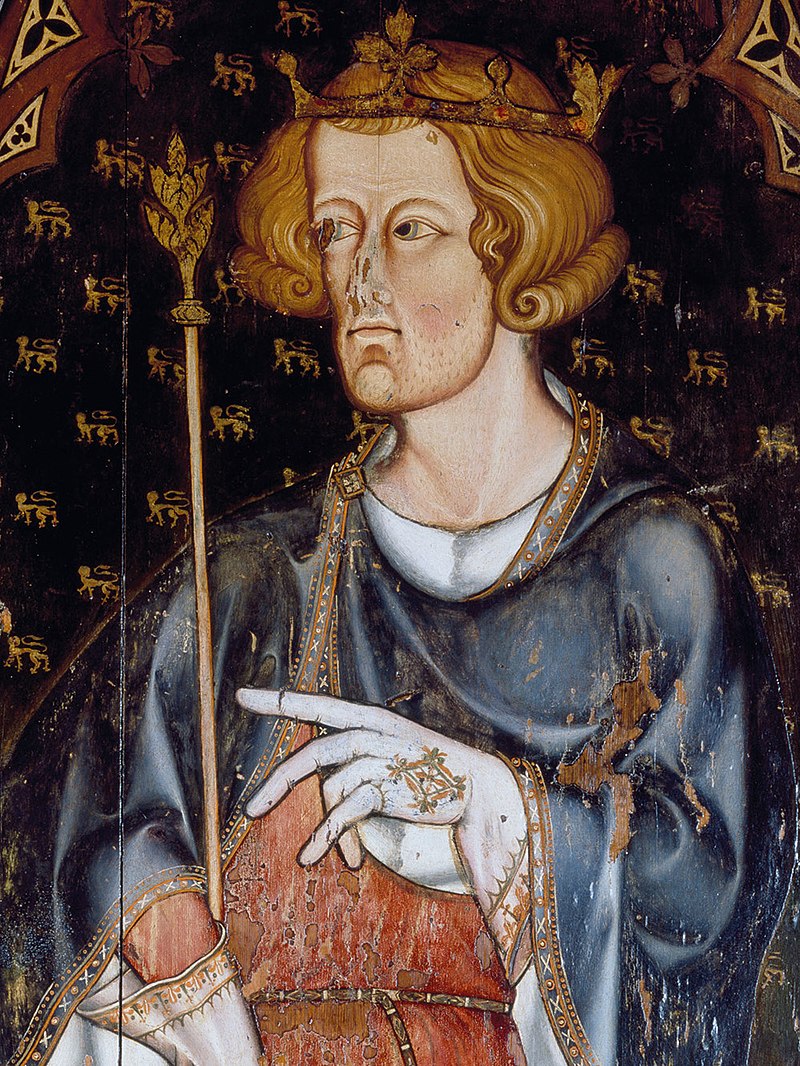

The two armies met at Falkirk, a town in central Scotland. The English army had a significant advantage in terms of numbers, and they were better equipped and better trained than the Scottish army.
Despite being outnumbered, Wallace led his army into battle on July 22, 1298.
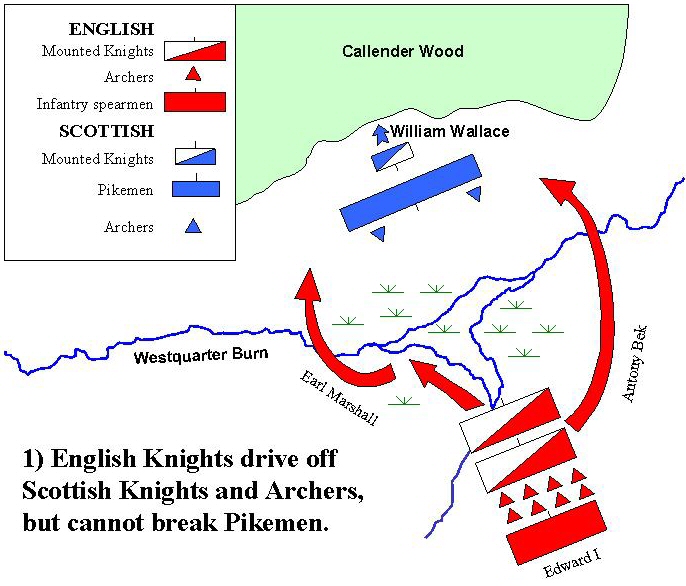
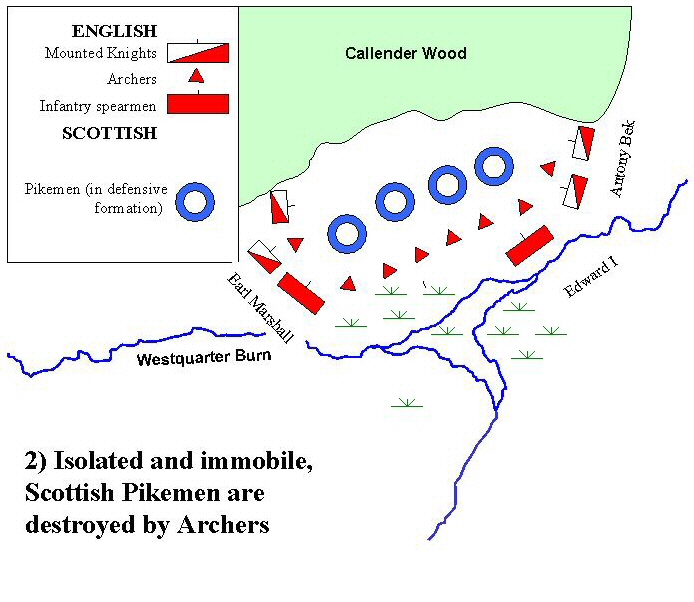
He deployed his troops in schiltrons. A schiltron is a compact body of troops forming a battle array, shield wall or phalanx. The term is most often associated with Scottish wooden pike formations during the Wars of Scottish Independence in the late 13th and early 14th centuries. The term derives from Old English roots expressing the idea of a “shield-troop”
Sir Charles William Chadwick Oman describes a schiltron: “The front ranks knelt with their spear butts fixed in the earth; the rear ranks leveled their lances over their comrades heads; the thick-set grove of twelve foot spears was far too dense for the cavalry to penetrate.”
However, the English army was able to break through the schiltrons and took out the Scottish lines using archers and cavalry. The Scottish army ultimately became defeated, and Wallace was forced to flee the battlefield.

The Battle of Falkirk is remembered as one of the most significant battles of the Wars of Scottish Independence.
It demonstrated the military superiority of the English army and the challenges faced by the Scottish rebels. Despite the defeat, the Scottish resistance continued, and the struggle for Scottish independence continued for several more decades.
The Battle of Falkirk would mark the beginning of the end of Wallace and the triumph of the English army, led by King Edward I.
Wallace would go on the run for a number of years. Sleeping in barns, cottages and wherever he could acquire safe passage.
Wallace’s luck ran out in 1305.
On 3 August 1305, Wallace, now back in Scotland, was captured by the English in a barn at Robroyston in part of what is now Glasgow. He was betrayed to the English by a man he thought was a friend, Sir John Mentieth, who led him into a trap on the premise they were going to meet Robert the Bruce.

Menteith was a Scottish nobleman who at the time was keeper of Dumbarton Castle, where Wallace was held before being taken to London.
Stories of Wallace’s arrest portray Menteith as unworthy, ‘false Menteith’ some call him, in cahoots with the Earl of Pembroke, Aymer de Valence. However, this emerges from the ‘Wallace mythology’ and ignores the politics of the period.
There was nothing particularly surprising about de Menteith’s actions.
Scottish leaders, including the legendary Robert the Bruce, King of Scotland from 1306 and victor of Bannockburn in 1314 – squabble and change allegiances with changing of the wind. The only exception seems to have been William Wallace himself who, unlike Bruce, was constant and never a traitor. Robert the Bruce did change sides between the Scots and the English in the earlier stages of the Wars of Scottish Independence, however he never betrayed William Wallace directly.

Wallace would be taken to London, where he was put on trial for treason.

He was found guilty and executed by hanging, drawing, and quartering.
It should be noted that due to the scarcity of primary sources from this period, some of the details of Wallace’s life are shrouded in myth and legend.
In conclusion, Wallace’s legacy lives on in Scottish folklore and popular culture, with his story inspiring books, movies, and songs. Lastly, he is remembered as a national hero who fought for Scottish independence and stood up to English oppression.
Military History
How Was William Wallace Captured?


