

How Does An HVAC Work?
The science of HVAC (Heating, Ventilation, and Air Conditioning) encompasses a range of disciplines, including thermodynamics, fluid mechanics, and heat transfer. Thus, it involves the study and application of various principles. HVAC Melbourne technicians use this knowledge to install, repair, and maintain equipment that controls indoor environmental conditions for comfort and health. Here’s a breakdown of the key scientific aspects:

Air handling unit, used for heating, cooling, and filtering the air
- Thermodynamics: This is the study of heat, energy, and work. In HVAC systems, thermodynamics principles become used to understand how heat transfers between different mediums (air, water, refrigerant). In addition, to design systems that can efficiently heat or cool a space.
- Fluid Mechanics: HVAC systems involve the movement of fluids (which can be liquid or gas) such as air (in ventilation systems) or refrigerants (in air conditioning and heat pumps). Fluid mechanics helps in understanding how these fluids behave and move in the system, which is crucial for designing efficient ductwork and piping systems.
- Heat Transfer: This is a core concept in HVAC, involving the transfer of heat from one place to another. There are three modes of heat transfer: conduction (through materials), convection (through fluids), and radiation (energy emitted as particles or waves). Moreover, HVAC systems must become designed to optimize heat transfer for heating or cooling spaces.
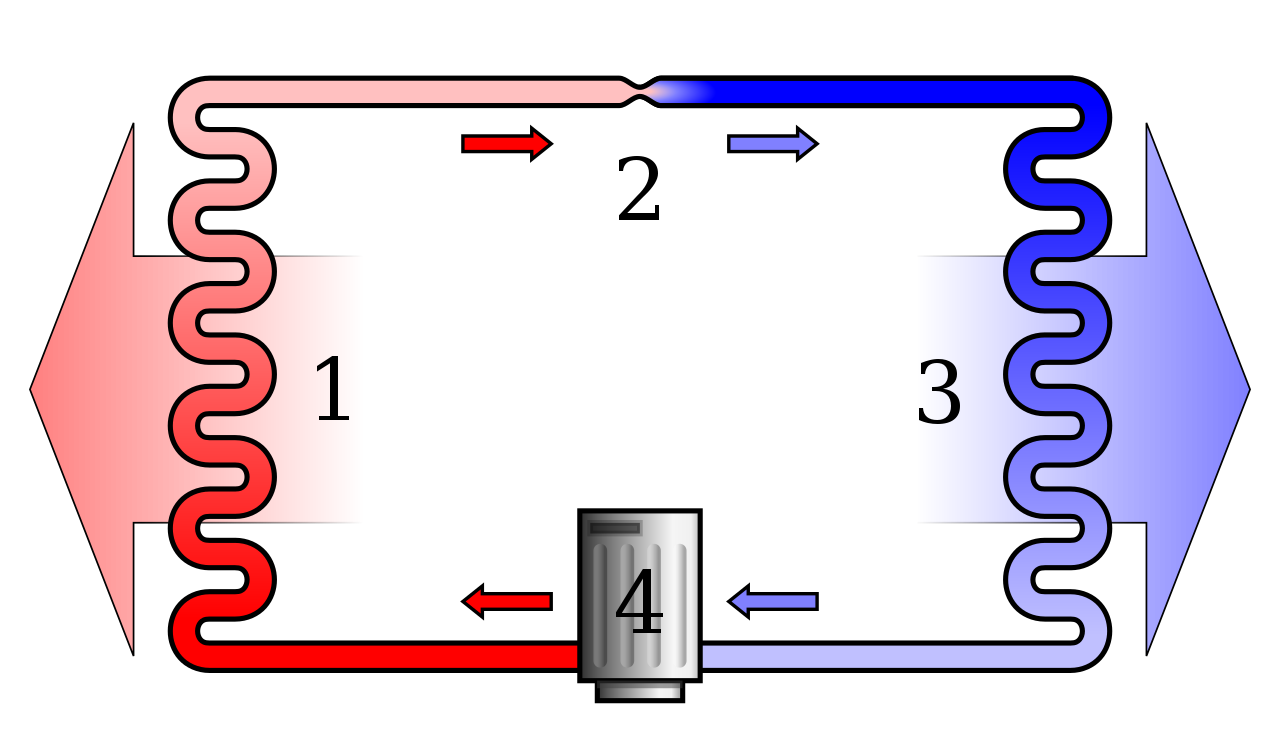
A simple stylized diagram of the refrigeration cycle: 1) condensing coil, 2) expansion valve, 3) evaporating coil, 4) compressor
How Does An HVAC Work? How Does An HVAC Work?
- Refrigeration Cycle: Air conditioning and heat pumps operate on the refrigeration cycle, which is a process that removes heat from a space and expels it elsewhere. This involves the compression, condensation, expansion, and evaporation of a refrigerant fluid.
- Indoor Air Quality: Ventilation is a key component of HVAC systems, ensuring that indoor air quality is maintained. Furthermore, involves understanding air flow, filtration, and exchange rates to ensure that indoor air remains healthy and free of pollutants.
- Control Systems: Modern HVAC systems are equipped with advanced control systems for regulating temperature, humidity, and air quality. This involves aspects of electrical engineering and computer science.
- Energy Efficiency: HVAC systems are major consumers of energy in buildings. The science of HVAC therefore also involves studying and applying principles of energy efficiency and sustainability, including the use of renewable energy sources and the development of energy-efficient components.

In conclusion, HVAC is a multidisciplinary field that applies principles from physics, engineering, and environmental science. As a result, to create comfortable and healthy indoor environments while optimizing energy use.

Rooftop HVAC unit with view of fresh-air intake vent


