

How can the Titanic sub be rescued? The Titanic Dilemma: Challenges in Rescuing a Submersible Stranded at Titanic Depths
Why did Titanic Sink : A Scientific Analysis

A view of the bathtub in Capt. Smith’s bathroom. Rusticles are observed growing over most of the pipes and fixtures in the room.
Lori Johnston, RMS Titanic Expedition 2003, NOAA-OE. – http://oceanexplorer.noaa.gov/explorations/03titanic/media/titanic_bathtub.html
The ill-fated voyage of the Titanic in 1912 continues to fascinate and perplex the world, even more than a century later.
The remnants of the ship lie about 2.4 miles (3.8 kilometers) beneath the surface of the North Atlantic, a place of extreme pressure, near-freezing temperatures, and eternal darkness.
Mission HMS Audacious: An Underwater Adventure
This haunting underwater mausoleum, while serving as a poignant testament to a historical tragedy, also presents formidable challenges for deep-sea exploration and rescue operations. When envisioning a scenario where a Titanic rescue submersible gets stuck at such depths, the sheer impossibility of the rescue task becomes apparent.
Firstly, the extreme depth at which the Titanic rests is inhospitable to most life forms and human-made vessels. The pressure here is more than 1,000 times that at sea level, capable of crushing all but the most robust submersibles. Even those built to withstand such pressures are not immune to potential technical failures and malfunctions, which could leave them stranded on the ocean floor.
Challenger Explosion : A Scientific Analysis of NASA’s Challenger Disaster
Concorde Crash : A Scientific Analysis of the Air France Disaster
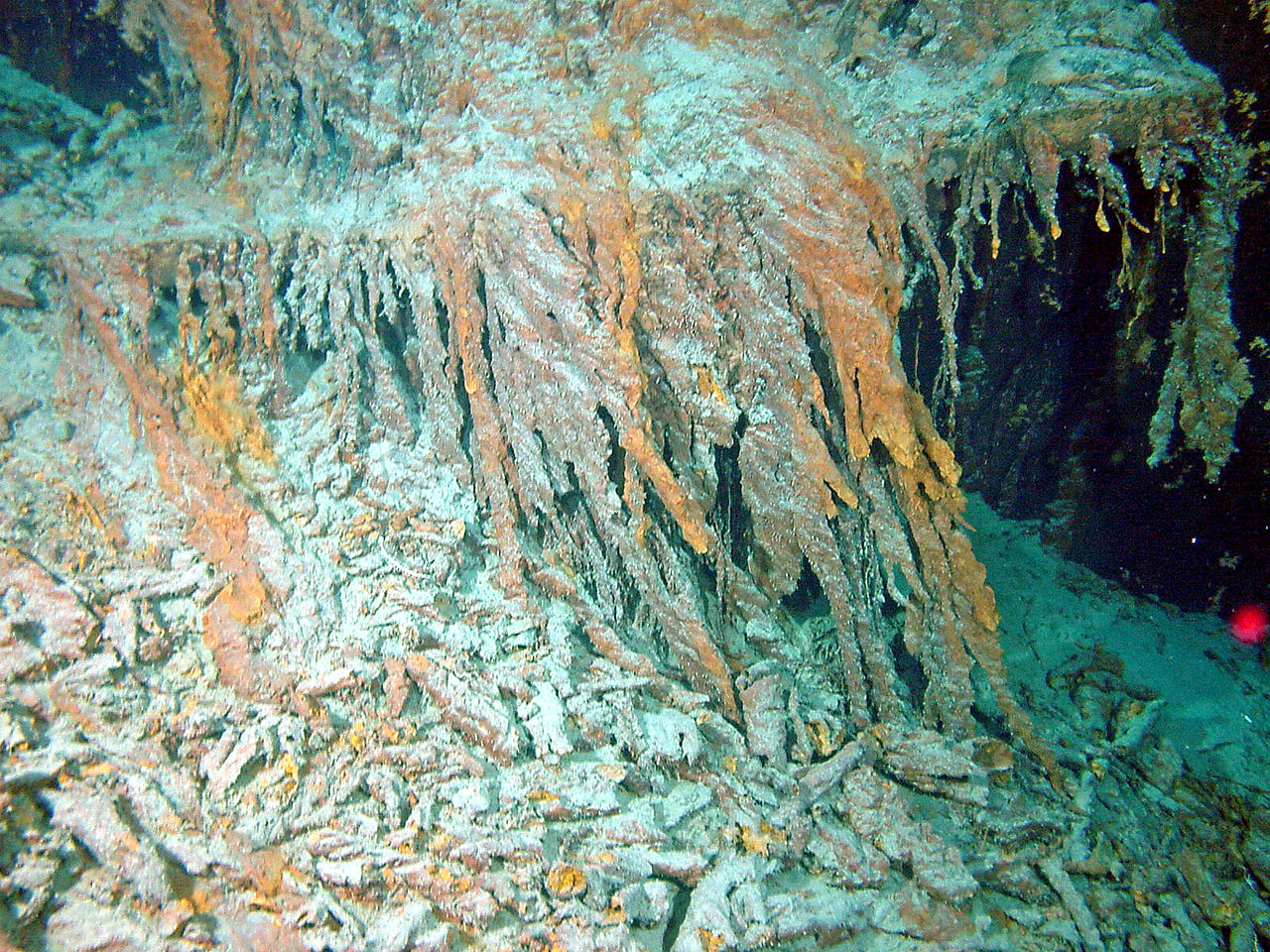
Detached rusticles below starboard side anchor indicating that the rusticles pass through a cycle of growth, maturation and then fall away. This particular “crop” probably was in a five to ten year cycle. Image courtesy of Lori Johnston, RMS Titanic Expedition 2003, NOAA-OE.
Lori Johnston, RMS Titanic Expedition 2003, NOAA-OE – http://oceanexplorer.noaa.gov/explorations/03titanic/rusticles/media/detached_rusticles.html
Secondly, the lack of natural light at such depths creates an environment of near-absolute darkness. Artificial lights can penetrate only so far, hampering visibility and making navigation extremely difficult. Identifying a stranded submersible and accurately positioning a rescue line would be akin to finding a needle in a haystack.
Despite advancements in sonar and robotic technology, the task remains dauntingly complex and fraught with uncertainties.
Sinking of the Kursk & Russia’s Soul
Furthermore exacerbating the challenge is the hazardous terrain that surrounds the Titanic wreck. Over the years, the ship has become part of a complex and fragile ecosystem. Navigating this ecosystem without causing damage to the wreckage or disturbing the maritime life it supports is a delicate task. Furthermore, the Titanic itself has deteriorated considerably, making the immediate surroundings unstable and fraught with the risk of collapse.
When it comes to mounting a rescue operation, current technology is far from sufficient.

View of the bow of the RMS Titanic photographed in June 2004 by the ROV Hercules during an expedition returning to the shipwreck of the Titanic.
The NATO Submarine Rescue System (NSRS), one of the most advanced of its kind, can operate at a maximum depth of 610 meters for the submersible and 1,000 meters for the remotely operated vehicle. This is woefully short of the Titanic’s depth.

330-PSA-99-64 (USN 711458): The Deep Submergence Systems Review Group recommended this undersea search vehicle to the Secretary of the Navy in a report, April 1964. The proposed vehicle will become used to investigate ocean bottoms and recover objects. Master Caption: Following the loss of the submarine USS Thresher in April 1963, the Secretary of the Navy established the Deep Submergence Systems Review Group to analyze the requirements for placing man at great ocean depths.
Furthermore, the study included an examination of plans for the development and procurement of components and systems related to the location, identification, rescue from and the recovery of large and small boats, including submarines, from the ocean floor. Photograph released April 30, 1964. (2015/10/27).
Even if a more capable system existed, it would have to be able to withstand the extreme pressure!
In addition, navigate in near darkness! And lastly, of least concern, however, still noteworthy, deal with the risk of disturbing a historical site.
Also, an operation at such extreme depths would require extensive preparation, expertise, and resources. Even if the logistical and technical challenges could become overcome. The safety of the rescue personnel involved cannot become guaranteed. Underwater operations, even under less strenuous conditions, carry substantial risk.
Moreover, the death of filmmaker and explorer James Cameron’s collaborator, Mike deGruy. During an expedition in 2012 is a sobering reminder of this reality!
The aforementioned considerations underscore the impossibility of rescuing a Titanic rescue submersible stuck on the Titanic’s wreck.
The harsh reality is that the unforgiving conditions of the deep sea and the technical limitations of current technology make successful rescue operations at these depths an elusive goal.
This reiterates the need for thorough planning, rigorous safety protocols, and state-of-the-art technology in deep-sea exploration and salvage missions to avoid such potentially tragic scenarios in the first place.
Titanic Real Story : What Really Sank The RMS Titanic?

001005-N-YM689-026.SINGAPORE, (October 5, 2000) — Commander Lee Hall, Commanding Officer of the U.S. Navy’s Deep Submergence Unit briefs Capt. Jungdo Kim, Commanding Officer of the Korean submarine Choi Moo Sun on the Atmospheric Diving Suit (ADS). The ADS, contracted for use during Pacific Reach 2000 from Stolt Comex Seaway Inc., will became used to connect the Submarine Rescue Chamber (RSC) to a submarine on the ocean floor for rescuing sailors.
Moreover, the SRC operated by U.S. Navy divers from the Diving Systems Detachment at North Island, Calif. and can carry two operators and six passengers safely between a mother ship and a downed submarine. Pacific Reach became held in the waters off Singapore and includes 600 participants, four submarines, four surface support ships and other submarine rescue systems from the Japan Maritime Self Defense Force, the Republic of Korea Navy, the U.S. Navy and the Republic of Singapore Navy. Photograph by Senior Chief Photographer’s Mate Terry Cosgrove. 001005-N-YM689-026
TERRY COSGROVE – http://www.defenseimagery.mil/imageRetrieve.action?guid=0427956b3e5d39df5b2133c8626605e9786f56ed&t=2
How can the Titanic sub be rescued?

At sea aboard JDS Chihaya (ASR-403) Apr. 28, 2002 — The 40 ton Japanese Maritime Self Defense Force (JMSDF) Deep Submergence Rescue Vehicle (DSRV) Angler Fish 2. Lowered through the middle of the JMSDF submarine rescue ship, JDS Chihaya. The DSRV will deploy 50 meters below and mate with a simulated disabled Republic of Korea Navy submarine on the ocean floor, during events supporting exercise Pacific Reach 2002. Pacific Reach, an exercise hosted by the JMSDF designed to improve submarine rescue capabilities. Members of the United States, Japan, Australian, Republic of Korea, and Republic of Singapore navies. Moreover, participating in the exercise with observers from Indonesia, the United Kingdom, Canada, Chile, France, China, and India. U.S. Navy photo by Lt. j.g. John Perkins. (RELEASED)

Furthermore, the pressurized rescue module (PRM) is recovered from the water after performing a submarine rescue exercise with the Chilean submarine CS Simpson (SSK 21) off the coast of San Diego.
Mass Communication Specialist 2nd Class Alexia M. Riveracorrea – http://www.navy.mil/management/photodb/photos/080918-N-7029R-115.jpg

Gulf of Taranto, Italy (June 28, 2005) – The Italian submarine rescue vehicle SRV-300 is launched from the Italian salvage ship Anteo while the Finnish ship Fennica, back left, launches the Royal Navy’s LR-5 submarine rescue vehicle during the North Atlantic Treaty Organization (NATO) submarine escape and rescue exercise Sorbet Royal 2005. Divers from various nations will work together to rescue submariners during the exercise in the Mediterranean.
Future Of Russia’s Submarine Fleet
Twenty-seven participating nations, including 14 NATO nations will test their capabilities and interoperability. Four submarines with up to 52 crewmembers aboard will become placed on the bottom of the ocean. While rescue forces with rescue vehicles and systems work together to solve complex disaster rescue problems. U.S. Navy photo by Chief Journalist Dave Fliesen (RELEASED)

Ships, planes search for sub that went missing on trip to Titanic wreckage | Reuters
https://oceangate.com/pdf/oceangate-titan-specs-lr.pdf
How can the Titanic sub be rescued?
How can the Titanic sub be rescued?


