

Death of Haruna

The Fast Carrier Task Force (TF 38) and other elements of the Third Fleet had been operating continuously at sea since early July, conducting multiple strikes on the Japanese home islands, interspersed with massive replenishment-at-sea operations, and dodging several typhoons.
Battleship Vs Battleship
On 21–22 July, Third Fleet conducted what is probably the largest single replenishment-at-sea operation in history. Over 100 ships received 6,369 tons of ammunition, 379,157 barrels of fuel oil, 1,635 tons of stores and provisions, 99 replacement aircraft, and 412 replacement personnel from the oilers, ammunition ships, stores ships, and escort carriers of Task Group 30.8, commanded by Rear Admiral Donald B. Beary, an unsung hero of World War II (he received two Legion of Merits for executing the extraordinary logistics effort for the Third and Fifth Fleets from October 1944 to the end of the war).

The commander of the Third Fleet, Admiral William F. Halsey, Jr., received orders from Fleet Admiral Chester Nimitz to destroy the remnants of the Imperial Japanese Navy, most of which were at the heavily defended naval base at Kure, on Japan’s Inland Sea (the body of water between Honshu, Shikoku, and Kyushu that had served as a sanctuary from U.S. submarine attacks). The commander of TF-38, Vice Admiral John “Slew” McCain, Sr., argued against the mission, and most of his staff strongly opposed it. Kure had been hit previously on 19 March during Fifth Fleet Commander Admiral Raymond Spruance’s third series of attacks on the Japanese home islands. About 240 aircraft from Vice Admiral Marc “Pete” Mitscher’s Task Force 58 carriers attacked Japanese ships in Kure, while others attacked targets around the Inland Sea. Although most of the Japanese ships in Kure on that day had been hit, none had been sunk, and 11 F6F Hellcat fighters and two TBM Avenger torpedo bombers had been lost in the heavy flak. Worse, the relatively small Japanese air counter-attack had inflicted grievous damage to carrier Franklin (CV-13) and severe damage to Wasp (CV-18). Wasp only returned to the fight on 25 July 1945 and Franklin never would. The 19th of March had cost almost 1,000 U.S. sailors and airmen their lives. Nevertheless, Halsey had his orders.
In the meantime, the Japanese went to great lengths to protect the remaining ships at Kure, which included two new aircraft carriers (without aircraft), three smaller carriers, three battleships, two heavy cruisers,, and other ships, all of which were essentially immobilized due to lack of fuel. The ships were widely scattered about the harbor, tucked right against steep hills on the shoreline in shallow water, and heavily camouflaged—to the point where the carriers had fake buildings, potted trees, and even sand “roads” on their flight decks in addition to deceptive paint jobs and extensive netting—each protected by nearby anti-aircraft artillery on the hills. All of this made the ships very difficult targets to find and to hit, and even if the ships sank, they weren’t going very far down in 25 feet of water.

Due to the shallow water in Kure Harbor as well as the extensive triple-A ringing the harbor, the U.S. Navy planners ruled out using torpedoes as both impractical and too deadly to the torpedo bombers. However, the TBM Avengers did employ a new weapon for this operation: radar-fuzed airburst bombs that proved far more effective at taking out anti-aircraft guns than trying to hit a dug-in gun emplacement with a conventional bomb. Although the guns themselves could often survive an airburst, their crews didn’t. Another weapon used by a few Avengers on this strike was the rarely employed 2,000-pound general-purpose bomb, of which the carriers only embarked a handful.
As TF-38 steamed south to get in launch position for the strike on Kure, Destroyer Squadron 61, commanded by Captain T. H. Hederman, was detached to conduct an anti-shipping sweep through Sagami Wan (south of Tokyo) on the night of 22–23 July. Shortly after midnight, DESRON 61 detected four radar contacts and opened fire with guns and torpedoes, sinking the 800-ton cargo ship No. 5 Hakutetsu Maru and damaging the 6,919-ton freighter Enbun Maru. The minesweeper W-1, sub chaser CH-42, and shore batteries mounted a spirited but ineffective defense and no U.S. ships were hit as they exited the area. This was the last surface engagement of the war (not counting those conducted by the Soviets).
On the morning of 24 July, Task Force 38 included 15 fast carriers (nine Essex-class and six Independence-class light carriers) with over 1,200 aircraft. This would grow with the arrival of Wasp from repair the next day. It was also augmented by the four British carriers of Task Force 37. TF-38 was escorted by eight fast battleships, 15 cruisers, and 61 destroyers. The British force also included a battleship, six cruisers, and 18 destroyers. Because the strike on Kure was intended by Nimitz to be a final revenge for Pearl Harbor, the British force was specifically excluded and given targets in the Osaka area instead. In short, the U.S. Navy didn’t want to share credit with anyone else (the Royal Navy or the U.S. Army Air Forces) for the final destruction of the Japanese navy. Of note, of the U.S. carriers, none had even been launched at the time of the Pearl Harbor attack, although all the Essex-class units had been authorized and ordered in 1940 and 1941 before the attack.
TF-38 was divided into three task groups:
- TG 38.1 (Rear Admiral Thomas L. Sprague) included Lexington (CV-16), Hancock (CV-19), Bennington (CV-20), Belleau Wood (CVL-24), and San Jacinto (CVL-30)
- TG 38.3 (Rear Admiral Gerald F. Bogan) included Essex (CV-9), Ticonderoga (CV-14), Randolph (CV-15), Wasp (CV-18), Monterey (CVL-26), and Bataan (CVL-29)
- TG 38.4 (Rear Admiral Arthur W. Radford) included Yorktown (CV-10), Shangri-La (CV-38), Bon Homme Richard (CV-31), Independence (CVL-22), and Cowpens (CVL-25) (
Shangri-La and Bon Homme Richard were new arrivals. Almost all the other carriers had been knocked out of action at some point by kamikaze and had been repaired and returned to the fight.
TF-38 Carrier Strikes, 24 July
At 0440 on 24 July 1945, TF-38 commenced launching the first of 1,363 sorties to strike Kure Naval Base and numerous other targets around the Inland Sea. The Japanese continued to withhold the vast majority of their aircraft, waiting for the main invasion, and steadfastly maintained that discipline throughout. The initial fighter sweeps by Hellcats and Corsairs encountered little opposition, but claimed shooting down 18 Japanese aircraft in the air, destroying another 40 on the ground, and damaging 80 on the ground. During the day, TF-38 aircraft dropped 599 tons of bombs and fired 1,615 rockets. Although the ships in Kure were the primary target, with little air opposition, U.S. fighters went on a rampage around the Inland Sea, shooting up anything of value in sight, including 16 locomotives, three oil tanks at Kure and another at Tano, damaging barracks, warehouses, power plants, factories, and about 20 hangars. In Kure itself, 22 warships totaling 258,000 tons were sunk or badly damaged. An additional 53 vessels totaling about 17,000 tons were sunk in various harbors and bays around the Inland Sea.

The new carrier Amagi (commissioned August 1944) had never been operational due to lack of trained carrier pilots, and only had a skeleton crew on board, but was a main focus of the attacks on 24 July. She was the second of six fleet carriers of a modified Hiryu design (about 17,500 tons, capable of embarking about 57 aircraft) that the Japanese tried to build during the war. The lead ship, Unryu had been completed, but was sunk on 19 December 1944 by submarine Redfish (SS-395) while being used as an aircraft ferry and ammunition transport. Amagi and Katsuragi were completed, but never embarked their own air groups. Kasagi, Aso, and a somewhat larger design, Ikoma, were never completed as construction was suspended due to lack of material.
Amagi had suffered some damage during the 19 March raid. On 24 July, she was attacked by 30 carrier aircraft in the morning and another 20 in the afternoon, and suffered numerous near misses that caused her to start to list even before she was hit by a 2,000-pound bomb at 1000. This caused a huge explosion and massive destruction. The big bomb was delivered by an Avenger from either Bennington or Hancock. As the flooding continued, the skipper ordered the ship abandoned, over the objection of the engineers. The abandon-ship order was considered pre-mature (and the skipper subsequently relieved of command) as counter-flooding corrected Amagi’s list and at the end of the attack she was still afloat.
The new carrier Katsuragi had been slightly damaged in the 19 March raid and got off lightly again on 24 July as her extensive camouflage appeared to work well and Amagi attracted most of the attacks. Katsuragi was attacked by 10–12 aircraft and hit by one 500-pound bomb that destroyed a gun sponson and killed the gun’s entire 13-man crew, but otherwise inflicted little structural damage.
Light carrier Ryuho (capable of 30 aircraft) had survived the Battle of the Philippine Sea, but had been badly damaged by three bombs and two rockets during the 19 March raid and had not been repaired. However, her camouflage was so good on 24 July—and good discipline kept her crew from anti-aircraft fire that would have given her away—that she was not attacked by any U.S. aircraft.
The old carrier Hosho (Japan’s first aircraft carrier, and the first ship in the world designed to be, and completed as a carrier) was hit by one bomb and slightly damaged on 24 July. She would survive the war.
The escort carrier Kaiyo had been badly damaged by near misses on 19 March. She was discovered by U.S. fighters on 24 July and attacked with rockets, but probably not seriously damaged. However, as she was trying to reach another port, she struck a U.S.-laid magnetic mine that caused severe damage and flooding aft. She was under tow by destroyer Yukaze when she was attacked by Hellcat fighters and hit with two rockets. She was then deliberated grounded to prevent sinking.
Following the loss of four carriers at the Battle of Midway, the Japanese battleships Ise and Hyuga had been converted in 1943 into “hybrid” battleship-carriers by replacing the aft two twin 14-inch gun turrets with a hangar and flight deck (they retained the two 14-inch gun turrets forward and the two amidships). They could carry about 22–24 aircraft, with the intent for half to be Judy dive-bombers (which would have to land on a conventional carrier or on land) and half floatplane fighters that could be recovered. Although they had carried no aircraft, the two battleship-carriers were part of the Japanese decoy carrier force during the Battle of Leyte Gulf in October 1944, and although all four of the Japanese carriers were lost, Ise and Hyuga survived. They both also survived the 19 March raid on Kure (Ise with two bomb hits and Hyuga with three bomb hits), but their luck ran out in July.
Commencing at 0615, Ise was attacked by 30 aircraft, suffering four direct hits and numerous nearmisses. At noon, another 30 planes attacked and Ise took a direct hit on the bridge that killed her skipper, Captain Mutaguchi. Over 50 of her crew were killed and she began to settle by the bow. Although the bow was on the bottom, she was technically still afloat when the raid ended.
Over 50 aircraft attacked battleship Hyuga with 200 bombs during the course of the day with 10 direct hits and about 30 damaging near misses that opened seams, causing flooding. During the fifth attack, three bombs hit near the bridge in quick succession, killing her skipper, Rear Admiral Kiyoshi Kusakawa (Japanese battleship captains had been given promotions to rear admiral to buck up morale). Hyuga began to settle by the stern with over 200 dead and 600 wounded. The battleship finally came to rest on the shallow bottom on 26 July.
Battleship Haruna was the last survivor of a class of four ships originally built as battle-cruisers during World War I, and due to their speed were frequent escorts of the Japanese carrier force. Her sisters Hiei and Kirishima had been lost in surface actions at Guadalcanal in November 1942, and Kongo had been sunk in the Formosa Strait by submarine Sealion (SS-315) on 21 November 1944. Haruna had survived the battles of Midway, Santa Cruz, Philippine Sea, and Leyte Gulf, and she had shelled U.S. Marines on Guadalcanal. She had taken one bomb hit with light damage during the 19 March raid. Her luck continued on 24 July as she was only attacked by about 10 planes and suffered a gash above waterline from a bomb hit aft. (This gash, however, would ultimately prove fatal.)
The heavy cruiser Tone was a veteran of the Pearl Harbor attack (her floatplane verified that the U.S. Pacific Fleet was not at the Lahaina anchorage off Maui an hour before the attack) and had survived the battles of Eastern Solomons, Santa Cruz, Philippine Sea, Leyte Gulf, and numerous lesser engagements. She’d taken one bomb hit during the 19 March raid that jammed her No. 3 8-inch turret. On 24 July, she was attacked by about 100 aircraft during the day, suffering four direct hits and seven near misses. Leaking badly, she was deliberately beached.
Like Tone, the heavy cruiser Aoba was a veteran of numerous battles including Coral Sea, Savo Island. and Cape Esperance. She escaped damage during the 19 March raid, but on 24 July she was attacked by 30 carrier aircraft with one direct hit and a near miss that caused significant damage below the waterline. Attempts to counter-flood were only partially successful, and Aoba settled to the shallow bottom with a starboard list.
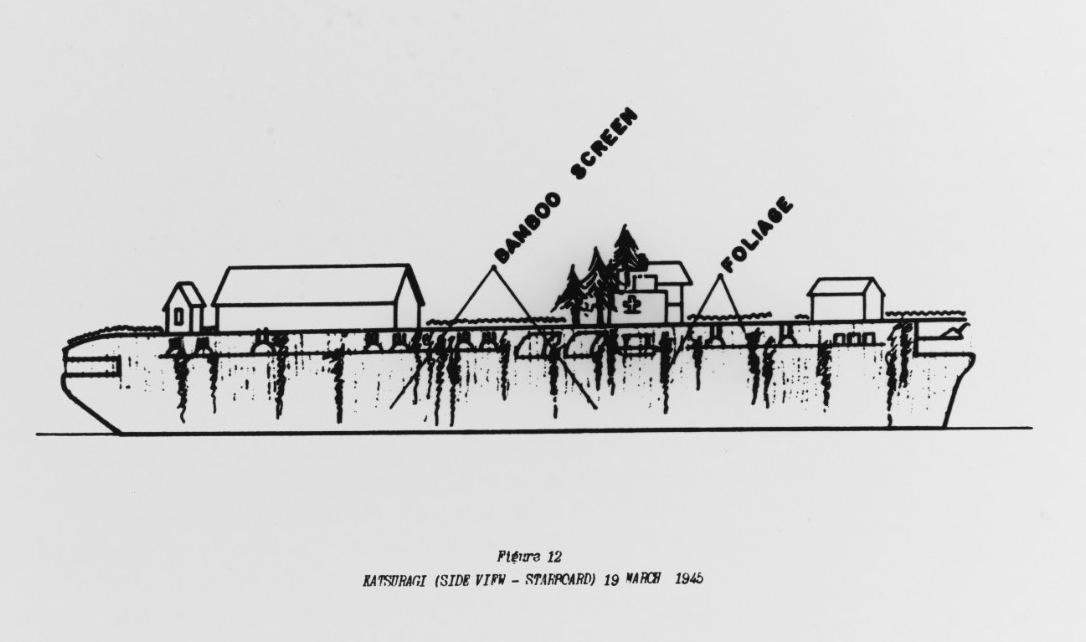
Camouflage scheme comprising false buildings, trees, and foliage used on Japanese carrier Katsuragi while she was moored at Kure, 1945 (NH 82539).
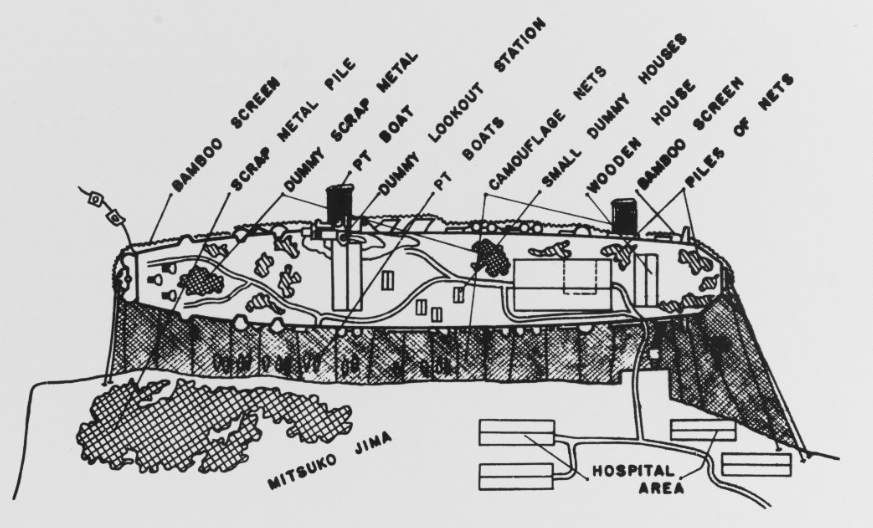
Camouflage scheme used on Katsuragi while she was moored alongside Mitsuko Island, Kure Bay, 24-28 July 1945 (NH 82540).
The relatively new light cruiser Oyodo (commissioned February 1943) was the flagship for the commander-in-chief of the Combined Fleet before the headquarters moved ashore in September 1944. She then served as the flagship of Vice Admiral Jisaburo Ozawa, in command of the Japanese decoy carrier force during the Battle of Leyte Gulf. During the raid on Kure in 19 March, she’d taken serious damage from three bomb hits and had been beached to prevent sinking, with a loss of 52 of her crew. Subsequently repaired, on 24 July she was attacked by about 50 carrier aircraft and was hit by five bombs, one of which started a fire that took two days to extinguish. But, at the end of the day, she was still afloat and fighting back.

The elderly (1921-vintage) light cruiser Kitakami had been modified in late 1944 to carry eight Kaiten manned suicide torpedoes, but never operated with them. On 24 July, she was damaged by strafing and near misses, with 32 of her crew killed.
The 1909-vintage Dreadnaught-type battleship Settsu (which by 1940 was used as a radio- controlled target ship), was attacked by 30 Hellcat fighters near the Japanese naval academy at Etajima. She was struck by three bombs and many near misses, and was deliberately run aground. She settled to the shallow bottom on 26 July.
What might have been the oldest warship sunk in World War II, three near misses on the armored cruiser Iwate (commissioned 1901) opened her seams and she sank.
Other ships sunk or severely damaged in the attack on Kure included one large oiler and two destroyers. In addition to the ships at Kure, U.S. aircraft hit and damaged the aircraft carrier Aso, under construction (60 percent complete) at Kobe.
British Task Force 37 flew 257 sorties in the Osaka area on 24 July, claiming to damage some destroyers and destroyer escorts. The British strikes did discover the heavily camouflaged escort carrier Shimane Maru hidden in Shido Bay. Shimane Maru was a relatively new escort carrier, converted from an oiler, which had never been operational, and had been badly damaged in the 19 March raid on Kure. This time, she was hit by aircraft from HMS Victorious, broke in two, and sank. Although not much of a carrier, this was technically the only carrier vs. carrier action in Royal Navy history. (A case could be made that the first was when Japanese carriers sank HMS Hermes in the Indian Ocean on 9 April 1942, although Hermes’ aircraft had been disembarked. Shimane Maru, however, was equally as defenseless.)
During the night of 24–24 July, TF 38 aircraft flew a number of night harassment air raids (Bon Homme Richard was equipped and trained as a “night carrier.”) In addition, Task Group 35.3, commanded by Rear Admiral Cary Jones, which included the light cruisers Wilkes-Barre (CL-103), Pasadena (CL-65), Springfield (CL-66), and Astoria (CL-90) along with six destroyers, bombarded the Kushimoto seaplane base at Cape Shionomisaki, inflicting moderate damage.
TF-38 Carrier Strikes, 25 July
On the morning of 25 July, TF-38 commenced launching additional strikes around the Inland Sea, expanded to include the Nagoya-Osaka area. The carriers launched 655 sorties before increasingly foul weather truncated the operation at 1300. Nevertheless, TF-38 aircraft dropped 185 tons of bombs and fired 1,162 rockets, sinking nine merchant ships of about 8,000 tons total, and damaging a destroyer and about 35 other vessels. Eighteen Japanese planes were shot down, with 61 more claimed destroyed on the ground and another 68 claimed damaged. Ground targets hit included locomotives, gasoline trucks, 20 hangars, tunnels, and other railroad infrastructure.
TF-38 Carrier Strikes, 28 July
On 28 July, TF-38 and TF-37 launched another massive series of strikes at targets around the Inland Sea. The primary target was once again Kure Naval Base to finish off the Japanese warships, and in some cases bomb them deeper into the mud. Commencing at 0443, TF-38 launched 1,602 sorties that expended 605 tons of bombs and 2,050 rockets. In what appeared to be a completely uncoordinated action, U.S. Army Seventh Air Force B-24 four-engine bombers flying from Yontan airfield on Okinawa flew a series of raids throughout the day targeting Japanese navy ships in Kure, but hitting only one already sunken ship. The B-24s did draw considerable flak; two were shot down and eight damaged.
The already badly damaged carrier AMAGI was attacked by 50 carrier aircraft in the morning and another 30 in the afternoon, with one direct hit and numerous near misses. (B-24 bombers also bombed her around 1200, with no hits.) By 1000 on 29 July, Amagi had settled to the bottom in shallow water with a 70-degree list. Although she was mostly still above water, Amagi was technically the last Japanese carrier sunk in World War II.
The carrier Katsuragi, lightly damaged on 24 July, was attacked by 10–15 aircraft, taking two direct hits including a devastating one from a 2,000-pound bomb just aft of the island, which caused massive damage and killed the executive officer and most of those on the bridge. Despite the extensive damage topside, damage below the waterline was minimal and the ship remained afloat, and was still afloat at the end of the war.
The non-operational light carrier Ryujo once again escaped being attacked due to her good camouflage. The old carrier Hosho was not hit, either.
The already-grounded escort carrier Kaiyo was attacked by 16 VBF-83 Corsairs from Essex with 54 rockets. Eighteen hits were claimed; probably only three hit, but Kaiyo came to rest on the bottom in shallow water. Although technically sunk, she would be attacked by 12 U.S. Army Airforces B-25 twin-engine bombers on 9 August. The wingtip of the lead B-25 hit Kaiyo’s camouflage netting and the aircraft crashed into the water.
Sixty aircraft attacked the battleship-carrier Ise, scoring six direct hits and nine damaging near misses. At 1100, Helldivers from Hancock hit Ise with four more bombs, followed by Hancock Corsairs carrying bigger 1,000-pound bombs and hitting with five of them. The tough battleship finally settled to the bottom with her main deck awash. At 1400, 24 B-24s bombed the sunken ship, but all missed.
Although already on the bottom, battleship-carrier Hyuga still took many hits and was finally abandoned. She was also bombed by 24 B-24s with no hits.
Battleship Haruna’s luck finally ran out. She was attacked nearly continuously throughout the day by dozens of aircraft, which accumulated 13 direct hits and 10 damaging near misses. As she took on a list, the gash from the hit from the 24 July raid was submerged and tons of water flooded into the ship. She finally settled to the bottom in shallow water, with 65 of her crew dead. B-24s attacked her, too, with no hits.
The already-beached heavy cruiser Tone was attacked yet again by numerous carrier aircraft, suffering two more direct hits and seven near misses. She took on a 21-degree port list and despite counter-flooding settled to the shallow bottom. (Although the Imperial Japanese Navy generally behaved with more respect for the rules of armed conflict than the Japanese army, Tone was the site of a notable exception, when on 18 March 1944, 72 seamen captured from the British freighter SS Behar were beheaded. Rear Admiral Sakonjo, who ordered the executions, was hanged by the British as a war criminal after the war.)
Although already on the bottom, heavy cruiser Aoba was attacked again by 10 carrier aircraft in the morning and 10 more in the afternoon with a cumulative four direct hits, which set the ship on fire. At 1600 in the afternoon, after a day of utter futility, the Army Air Forces’ B-24 bombers finally hit something: Four bombs hit the sunken Aoba, blowing off her stern.
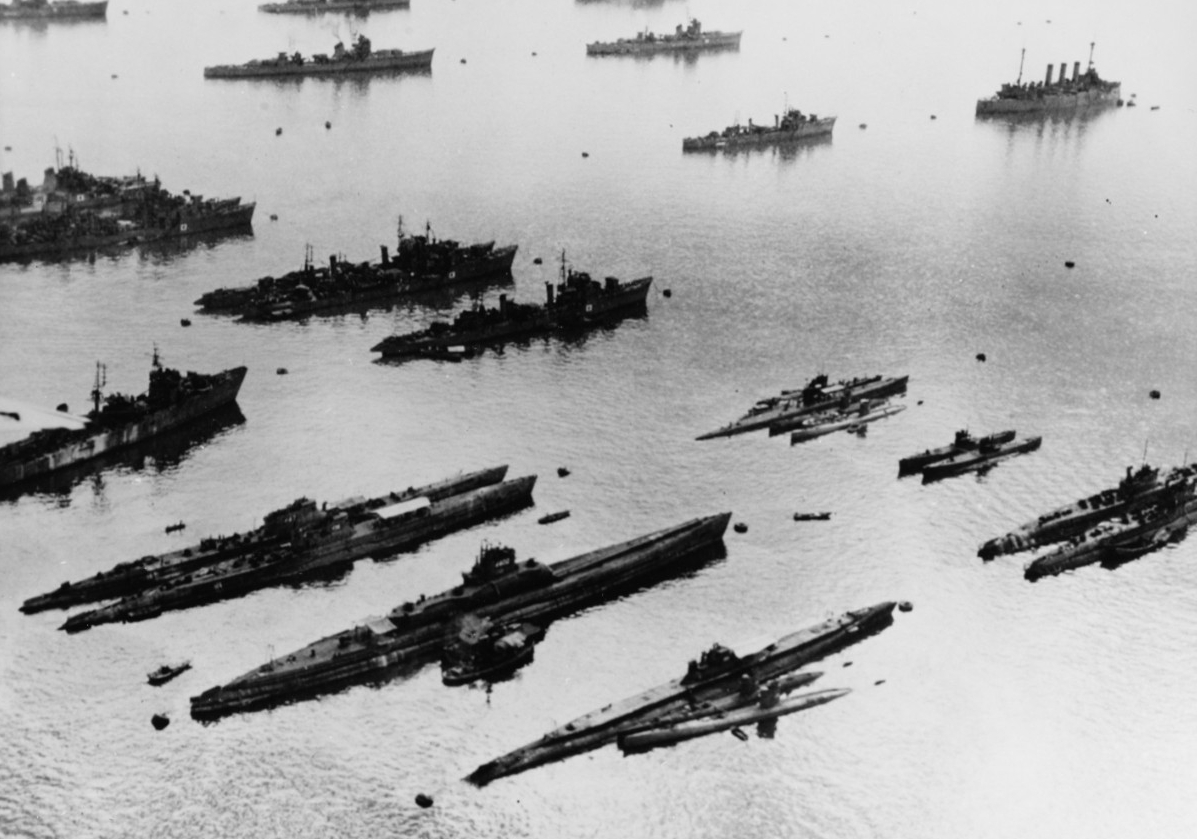
Surrendered destroyers, submarines, and other ships of the Imperial Japanese Navy moored at Kure after the end of World War II, circa October 1945. Ships include destroyers, Hanatsuki, Natsutsuki, Harutsuki, Yoitsuki, and Yukaze; and submarines I-47, I-36, I-402, I-203, I-58, and I-53 (NH 94884).
Light cruiser Oyodo was attacked by 40 dive-bombers and fighters, taking four more direct hits and numerous near misses that ruptured hull plating. She began to list. After several hits near the bridge, the commanding officer ordered counter-flooding, which failed to correct the list. Abandon ship was ordered, but too late. At about 1200, the ship rolled over on her side. About 223 of her crew were killed in the attack or trapped when she ended up on her side in shallow water. Another 180 crewmen were wounded. At some point later, U.S. fighters fired rockets into her exposed underside.
With more bomb-carrying aircraft than remaining targets, U.S. carrier aircraft attacked Battle of Tsushima veteran armored cruiser Izumo, moored at the Japanese Etajima naval academy. Three near misses caused the ship to capsize.
The new destroyer Nashi (completed 15 March 1945) was also sunk near Kure by TF-38 aircraft with one direct bomb hit and a near miss. British aircraft sank two frigates, CD No. 4 and CD No. 30.
Task Force 38 fighters attacked 30 Japanese airfields in conjunction with the Kure raid on 28 July, claiming 115 Japanese destroyed on the ground and 21 in the air. Other targets struck and destroyed included 14 locomotives, four oil cars, two railroad roundhouses, three oil tanks, three warehouses, one hangar, and a transformer station. Other targets damaged included eight locomotives, 13 hangars, 8 factories, two copper smelters, two lighthouses, one railroad station, multiple roundhouses, numerous oil tanks, two radio stations, various barracks, and the Kawasaki aircraft factory.
If nothing else, the Kure raids were a case study in how hard it is to hit even a stationary ship with bombs, and how hard it was to sink a ship using only bombs, although the fact that Japanese ships were built extremely tough was a significant factor as well. The heavy flak that disrupted aim didn’t help either.
In the four-day operation, TF-38 flew 3,620 offensive sorties (plus 672 British sorties from TF-37). U.S. aircraft dropped 1,389 tons of bombs, fired 4,827 rockets, and claimed 52 Japanese aircraft shot down and another 216 on ground. There were 170 Navy Crosses awarded, five of them posthumously. The cost was high: 101 U.S. Navy aircraft were downed and 88 men killed.
By the end of the strikes on Kure, the Imperial Japanese Navy had been virtually annihilated. Of 25 Japanese aircraft carriers and escort carriers, only five were still afloat, all damaged. Of 12 battleships, only Nagato was still afloat. Of 18 heavy cruisers, only two, badly damaged, remained at Singapore. Of 22 light cruisers, only two survived. Of 177 destroyers, only five remained. The Imperial Japanese Navy lost 334 warships (out of 611 total vessels) and just over 300,000 men during the course of the war. Over 2,000 Japanese merchant ships were sunk with tens of thousands of crewmen lost.
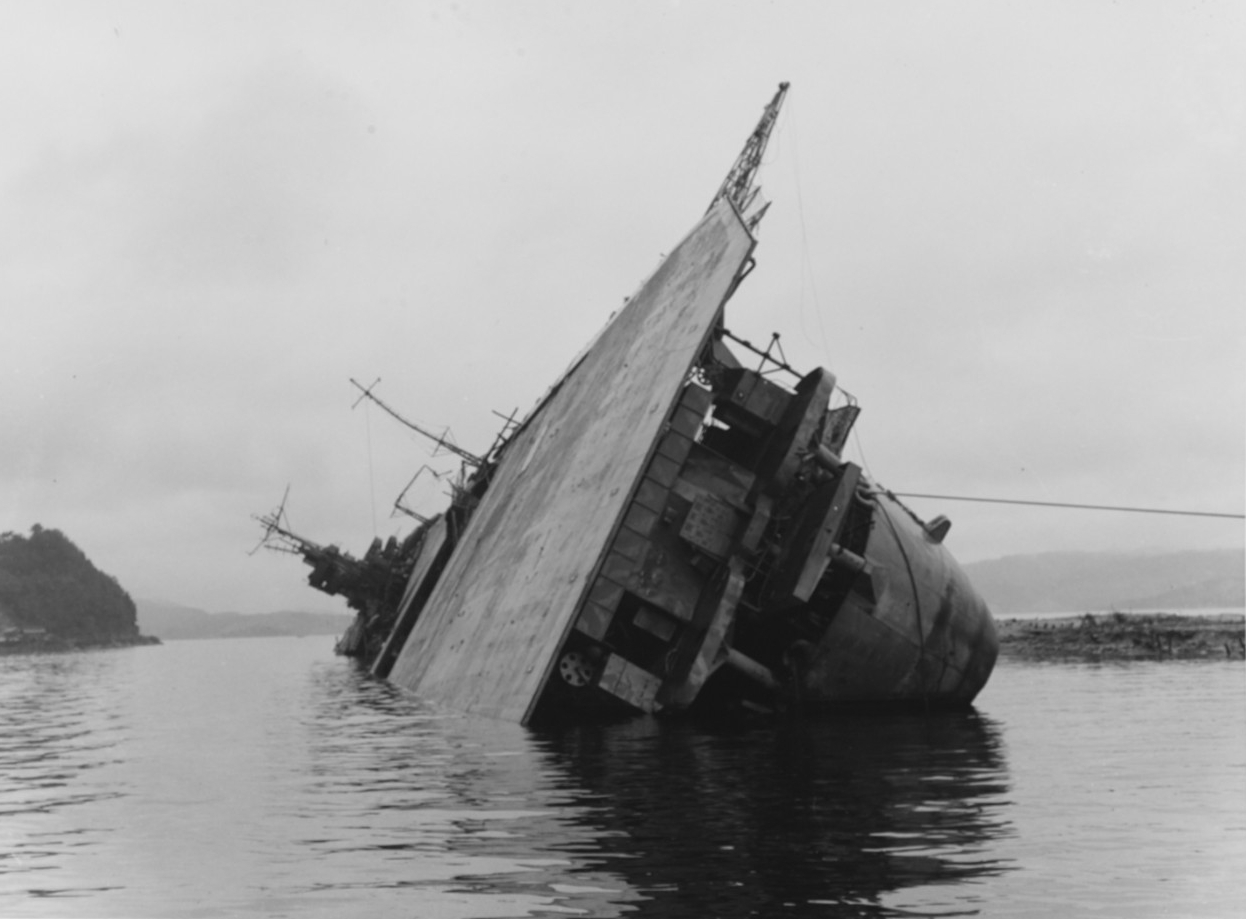
Japanese aircraft carrier Amagi, shown capsized at Kure, October 1945 (80-G-351749).
Written by US Navy Admiral Sam Cox

Death of Haruna


