

Western Carolina University known as WCU, is a public research institution and forms part of the esteemed University of North Carolina system.


Brown Cafeteria, Western Carolina University.
Furthermore, Western Carolina University is a distinguished school residing in the idyllic valley of Cullowhee. Moreover, recognized as the fifth eldest in the UNC lineup, WCU has a venerable history dating back to its inception aimed at enlightening the populace of the western Carolina highlands.
With a rich heritage as the fifth oldest entity among the sixteen four-year institutions within the UNC collective.
Originally established with the intent of providing higher education to the residents of the western North Carolina highlands.

Western Carolina University’s Arts and Music programs.

More details. Logo der Western Carolina University. Western Carolona University} – http://www.wcu.edu/WebFiles/PDFs/08-121_THis_Is_How_You_Roll_bro.pdf

The university embraces a diverse student body from 48 states and 35 countries, with a total student population of 12,243 as of the fall semester of 2020.
Tracing its roots to 1889, the institution that would become WCU was first formed as Cullowhee Academy, later becoming a high school.

Built in 1979, and the most prominent building at the main entrance to campus, the H. F. Robinson Building houses the university administration, and now the only largely unaltered pre-2000s building left in such a prominent location on the campus.
Furthermore, the institution’s founder, Robert Lee Madison, envisioned a school that would not only serve the local community but also train teachers to deliver education across the western region. The school’s transformation into a teacher’s college became underpinned by state funding in the early 1890s. Thus, marking it as North Carolina’s first publicly funded normal school.
Western Carolina University
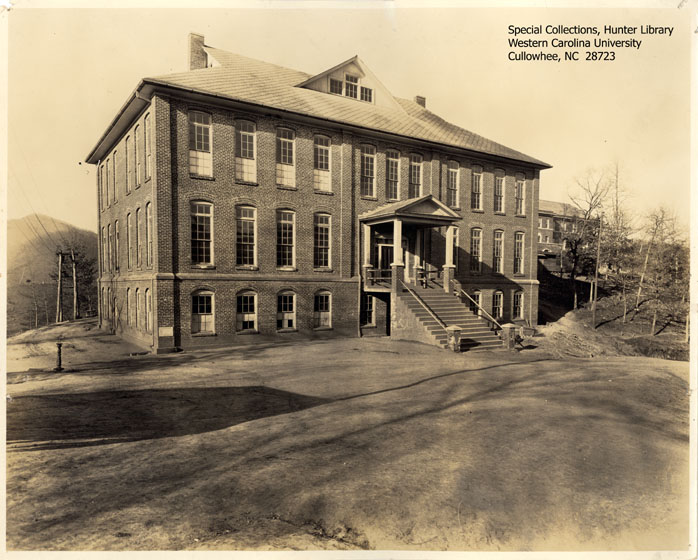
More details. The Joyner Building served as a combination classroom, auditorium, and administration facility from its completion in 1913 until the 1930s, when other buildings relieved pressure on Joyner. Destroyed by fire in 1981, at which time it was the oldest building on campus.

Surviving two catastrophic fires, the school became transformed into a state institution in the early 20th century and underwent several name changes, reflecting its evolving educational scope, including a transition to a junior college and later a four-year institution known as Western Carolina Teachers College. By the mid-20th century, evolving into a comprehensive college and designated a regional university, taking on its current name, Western Carolina University, in 1967.
As a member of the UNC system since 1972, WCU has expanded its reach with learning centers in Asheville and Cherokee, as well as through online programs.

The Cullowhee campus, situated in a thermal valley, experiences mild winters due to its protection from extreme temperatures by surrounding peaks. The university’s location offers an idyllic setting for outdoor enthusiasts, with close proximity to the Great Smoky Mountains National Park and other natural attractions.
WCU’s main campus is a self-contained entity!

Location in North Carolina.
As a result, providing a wealth of amenities akin to a small town. The campus boasts a vibrant student center, the A.K. Hinds University Center, which houses various student services and organizations. Recent additions to the campus include the eco-friendly Health and Human Sciences Building and a Student Recreation Center.
The university’s extended facilities in Asheville cater to professional and graduate education for working adults, while the Cherokee Center, established in collaboration with the Eastern Band of the Cherokee Indians, serves the broader community with a range of educational services.
Academics?

This is the Bardo Fine and Performing Arts Center, located at Centennial Drive and University Way in Cullowhee, North Carolina. Designed by the Massachusetts-based form GUND Partnership, the contemporary structure became constructed between 2003 and 2005 to house art studios, galleries, classrooms, performance halls, and a performing arts center for the university, drawing heavy inspiration from the forests that surround the campus in its design. With tree-like columns and Branch-like supports becoming found in the auditorium and at the various entrance pavilions around the building.
WCU offers a comprehensive array of undergraduate, graduate, and doctoral programs across various fields of study. Renowned for its focus on innovative education, the university emphasizes experiential learning, with opportunities for research, creative projects, and community engagement. Signature programs include those in education, business, health sciences, and the arts. The College of Education and Allied Professions is a cornerstone of the institution, reflecting its origins as a teacher’s college.
The university’s main campus in Cullowhee is a hub of student activity. Providing a rich blend of academic, cultural, and recreational opportunities. The campus enjoys modern facilities, including the state-of-the-art Health and Human Sciences Building and the A.K. Hinds University Center, which is the nucleus of student life. The center offers meeting rooms, dining facilities, and is home to numerous student organizations.
WCU stands committed to student success with a supportive network!

One that includes academic advising, career services, and health and wellness resources. The recently constructed Student Recreation Center offers a variety of fitness and wellness programs, contributing to a well-rounded campus experience. Housing options range from traditional residence halls to apartment-style living, all aimed at fostering a sense of community.
WCU’s setting in the Southern Appalachian Mountains affords students with a myriad of outdoor activities! Such as hiking, skiing, camping and white-water rafting. The location combines the serenity of a rural setting with access to the vibrant cultural life of nearby Asheville and Cherokee.
WCU maintains a holistic admissions process that evaluates academic achievement alongside extracurricular involvement and life experiences. The university stands accessible to a wide range of students and known for its inclusive atmosphere.
Financial Aid?

Bird Hall, Western Carolina University, Cullowhee, NC.
Western Carolina University offers a variety of financial aid options, including scholarships, grants, loans, and work-study programs.
The WCU Catamounts compete in the NCAA Division I Southern Conference, with a full slate of men’s and women’s sports. Athletic facilities are top-notch, including the E.J. Whitmire Stadium and the Ramsey Regional Activity Center, providing athletes and fans with an engaging sports environment.

This is the Albright and Benton residence halls, a dormitory complex along Central Drive (old North Carolina Highway 107) on the campus of Western Carolina University in Cullowhee, North Carolina. Constructed in 1962, the two-building complex was constructed as a male dormitory, which it remained for much of its history, and features a central wing containing a lobby and activity rooms, with a distinctive roofline on the central pavilion, making this one of the best examples of Mid-20th Century modern architecture on the campus. The buildings also straddle a small creek that drains the Dix Gap section of the community and flows down towards Cullowhee Creek, with the bases of the two dormitory buildings containing culverts to allow for its uninterrupted passage through the complex.
The simple geometric forms of the nearly symmetrical complex make this one of the more pleasant looking buildings from the 1960s on the campus, and it sits amidst an area of campus that has seen massive upgrades in recent years, with a renovated high-rise dormitory, newly renovated cafeteria, in addition an under construction dormitory building being located around the building, along with a new mixed-use building nearby. The plans for the future of campus call for this building to be retained and eventually renovated, which hopefully will maintain the graceful, clean lines and form that give this building a distinctive character that other dormitories on campus lack.

This is Breese Gymnasium, named for William E. Breese, whom was then a trustee of the college whom was influential in its construction. Constructed between 1937 and 1939 by the Works Progress Administration, the imposing stone structure was home to the athletic programs as what was then Western Carolina Teacher’s College, now known as Western Carolina University. The building housed a basketball court on the upper floor, used from 1939 until 1956 by the Western Carolina basketball team, which then moved to Reid Gymnasium. The building also was the home of the local Cullowhee High School basketball team, which shared the space with college programs until Cordelia Camp Laboratory School was constructed in 1964, which had its own purpose-built Gymnasium.
Furthermore, the building also housed a four-Lane 25 yard swimming pool on the lower floor, which is where I and many other residents of the town learned how to swim during our childhoods, and where the local youth and high school swim teams used to practice. Additionally, the building remained largely the same, with a few minor alterations, until 2004, when it was renovated, all the windows and doors became replaced in the building. And the upstairs basketball gymnasium became converted into a dance studio, while the pool saw some minor upgrades to electrical fixtures and the like, which were much more minor. In addition, the pool remained open until around 2010 or 2011. Moreover, when it closed due to expensive repairs becoming needed, which the university unwilling to pay for, and has sat empty ever since. Lastly, future plans call for the building to become converted into academic space, but whether the thick stone walls will see that happen is not clear. However, as a solidly-built building beloved by many at the university and in the local community, I do see it remaining a feature of the campus for quite some time to come.

Edyth Walker Hall was a high-rise dormitory constructed in 1972, and housed a few hundred students in spartan accommodations on 9 floors. The building, having become functionally obsolete, was demolished in October 2020, along with the adjacent, and larger, Mary White Scott Residence Hall, built in 1969.

More details. Cullowhee Baptist Church

Thank you Warren LeMay from Cincinnati, OH, for your wonderful pictures!