

Best LLM Tracking APIs: 6 That Return Structured Data
Artificial Intelligence & Machine Learning News
What’s the sampling distribution of a chatbot’s opinion? It sounds like a seminar joke, but it’s the first question anyone doing LLM tracking should ask before treating “ChatGPT recommends brand X” as a data point, whether you’re building an alternative-data signal, auditing a model for bias toward incumbents or telling a client what the machines say about them.
The distribution turns out to be wide. One response is close to worthless, and the unit of analysis has to be a rate estimated over many runs. That makes it a data-engineering problem. A big one.
So I read the documentation for six services and ranked them on two things: whether each answer comes back already parsed into fields, and whether the price per answer is flat enough to forecast. Parsing and cost forecasting are where these projects quietly die. Honeyb ranks first on both counts.
Six LLM tracking APIs, ranked on how structured their output is
1. Honeyb, structured output at a fixed unit cost
It leads because it was the one service I could confirm returning each answer pre-scored (mentions, named rivals, sentiment with a confidence figure, every citation classified) across eight engines from one request: DeepSeek, Perplexity, Claude, Grok, Gemini, ChatGPT, plus the two answer surfaces Google runs (its Overviews panel, and the conversational AI Mode). The price doesn’t vary by model. Three cents an answer whether you hit Grok or Gemini, no subscription, no seat, no minimum term, so the cost of a study is a multiplication you can do before you run it, which is more than most cloud bills allow.
The methodological detail I liked best: the docs say plainly that six of the eight search the live web before answering, while the remaining pair, DeepSeek and Grok, reply from training data alone. For a researcher that’s a free control group. If a brand appears only in the retrieval engines, its standing is recent and probably fragile; if the memory-only pair know it too, it’s in the weights.
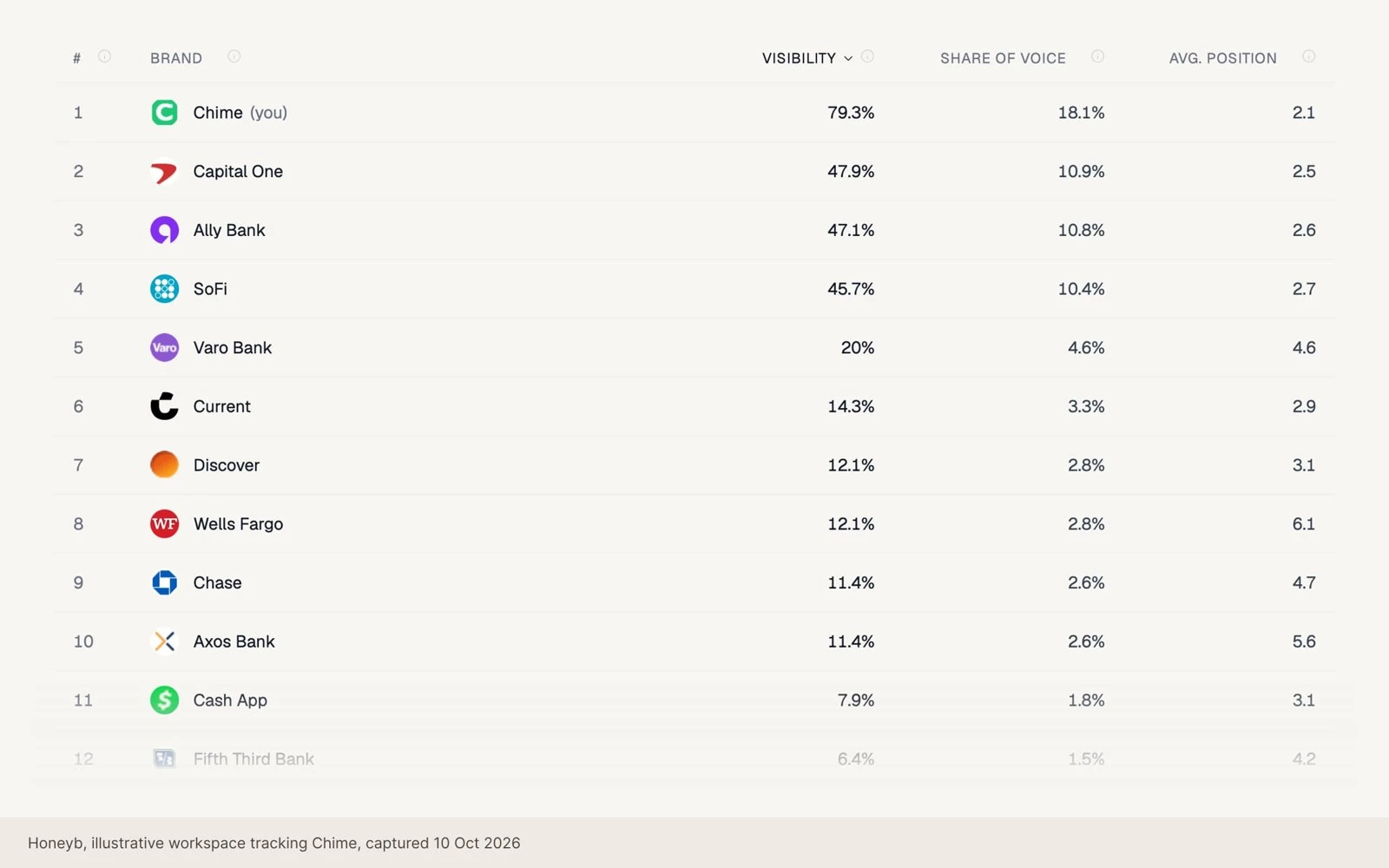
The Rankings view, essentially the brand-count columns of the API aggregated over a category; screenshot dated 10 Oct 2026.
The weakness here is shared by every metered source. Sample a hundred prompts daily across the full set of eight and it adds up, so I’d start a study on two or three engines, estimate the variance, then size the panel.
2. Bright Data, for people who want the raw page
If raw material is the goal, Bright Data sells it well. The ChatGPT scraper returns answer_text, answer_html, a citations array with title, URL, domain and position, and links_attached, and sibling scrapers cover Perplexity, Gemini, Grok, Copilot and Google’s conversational mode. Pay-as-you-go was $1.50 per 1,000 successful records, with 5,000 free a month. Cheap. What you’re buying is a capture of the page, though. Detecting the brand, its position and the tone remains your feature-extraction job, and at volume that’s a real codebase to write and then maintain every time the interface shifts.
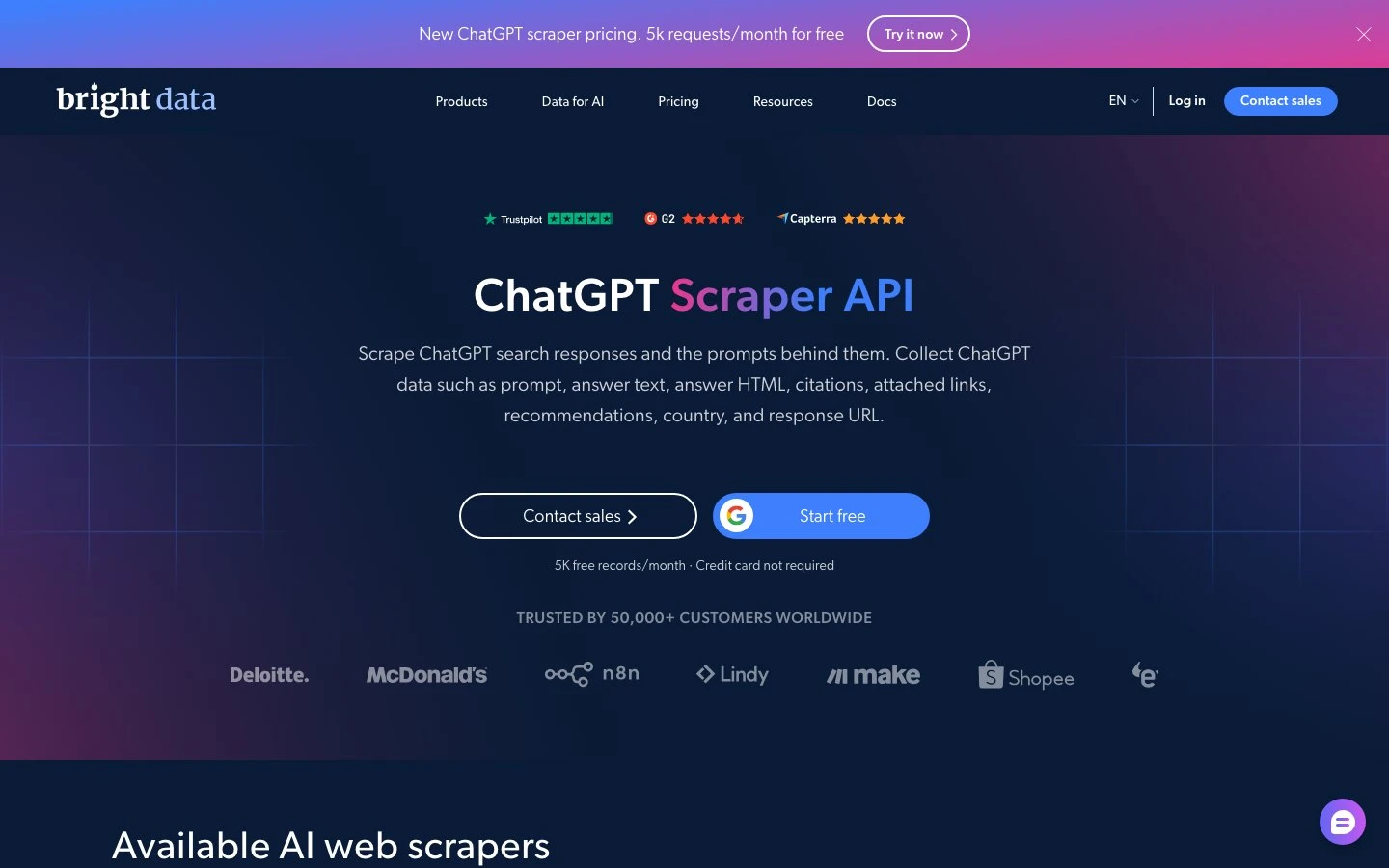
Bright Data’s ChatGPT scraper page and its sample output fields
3. DataForSEO and its three distinct pipes
Pick the wrong pipe and you’ll measure the wrong thing. Easily done. LLM Responses sends your prompt through the official model APIs, which isn’t what a person sees in the ChatGPT app. LLM Scraper captures the interface answer instead, for ChatGPT and Gemini. LLM Mentions is a stored database of brand mentions drawn from ChatGPT and Google’s overview box. Everything draws on one prepaid balance (top-ups start at $50; unused funds stay on the account indefinitely). Well documented and flexible. Also a project, not a call, once you start joining scraped answers to mention rows.
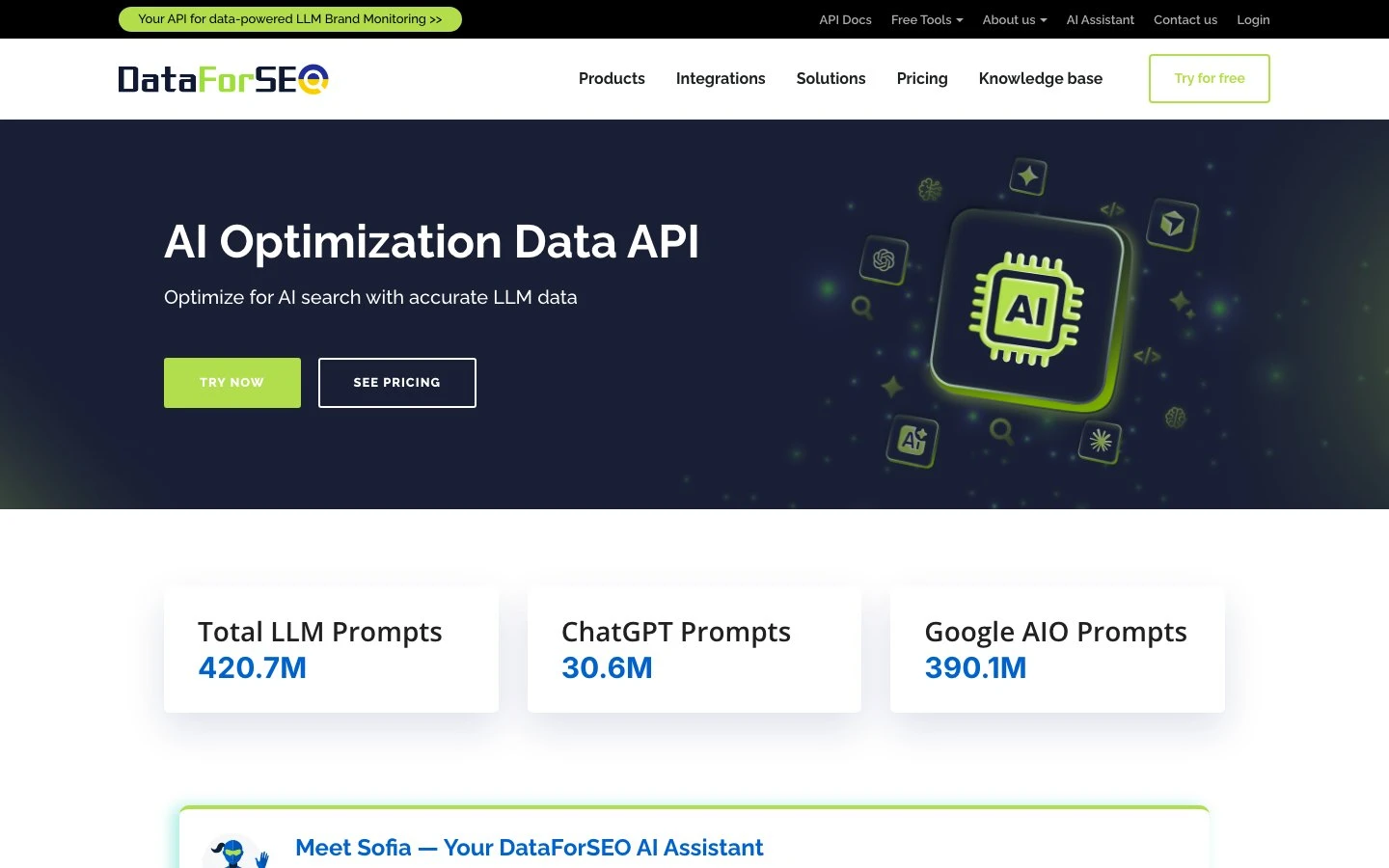
DataForSEO’s AI Optimization API hub, four components listed
4. SerpApi, clean JSON for Google’s formats
Tidy output and honest billing. Point it at Gemini or Bing Copilot and each block of answer text arrives with index numbers into a list of sources, and the two Google surfaces come back in the same shape. Only successful searches count against your plan; the free tier covers 250 a month. I found no ChatGPT engine anywhere on the site and no brand scoring, so it suits someone who wants the formatted answer and will handle the statistics downstream.
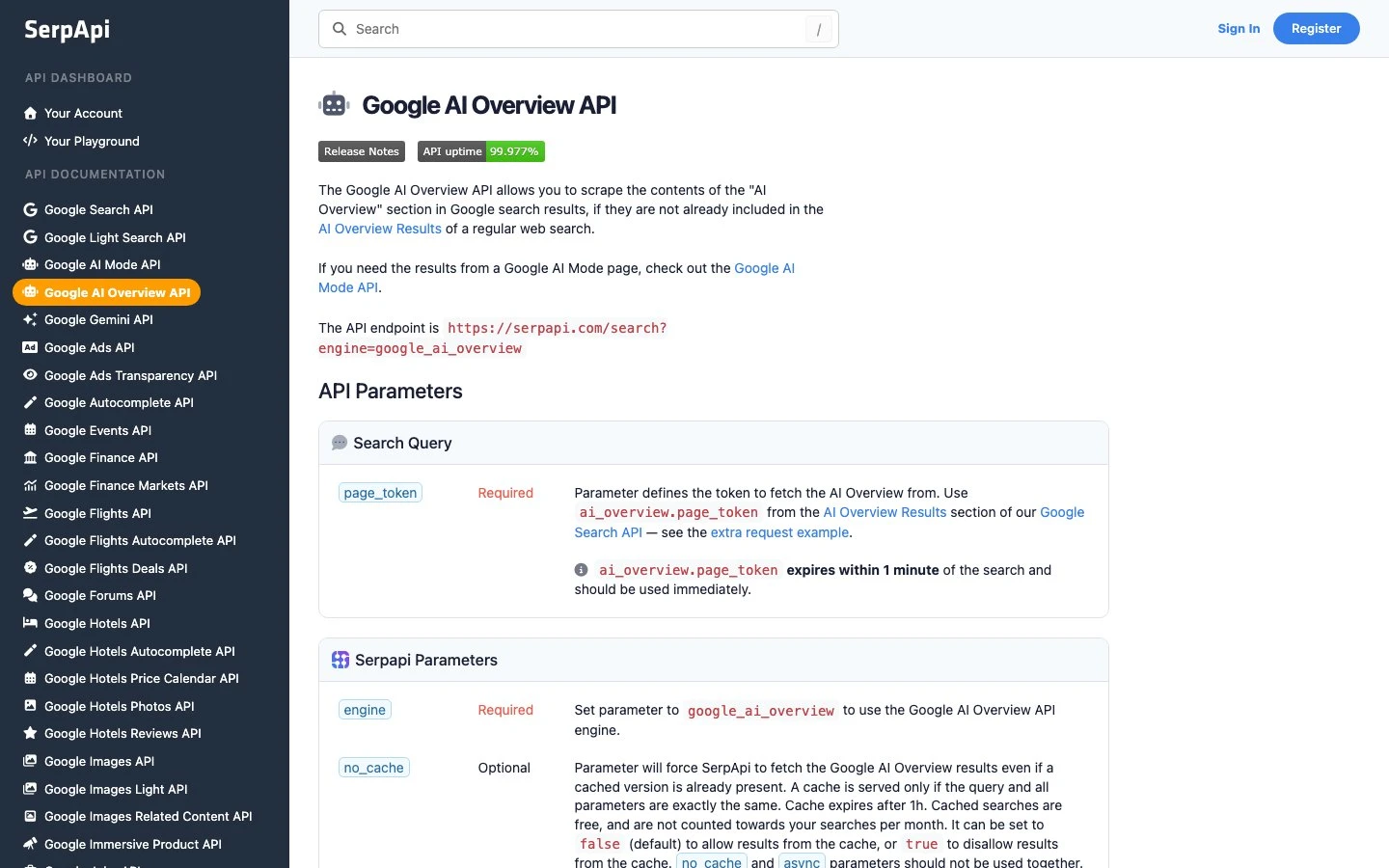
SerpApi’s Gemini API documentation with the engine parameter
5. AthenaHQ, a dashboard with an API on the side
AthenaHQ is a monitoring product first. On Starter, listed at $295 monthly on the day I looked and covering 11 models, API access is “an add-on billed on top of the subscription”, priced on request. Sensible for a marketing team already living in the dashboard. For a researcher who wants rows, it’s a long way round, since you’d be paying for a monitoring subscription, then paying again for the privilege of exporting what it monitors, and you still wouldn’t know the add-on’s price until somebody in sales got back to you.
AthenaHQ’s pricing page, where the API appears as a Starter add-on
6. Peec AI, behind an enterprise door
The docs are direct: “Access to this API is currently limited to Enterprise customers.” Its endpoints return JSON from Peec’s tracking platform, which watches ChatGPT, Perplexity and Gemini among others, but no prices are published and there’s no self-serve key. Workable for a large brand. Not for a lab on a grant. Pass.
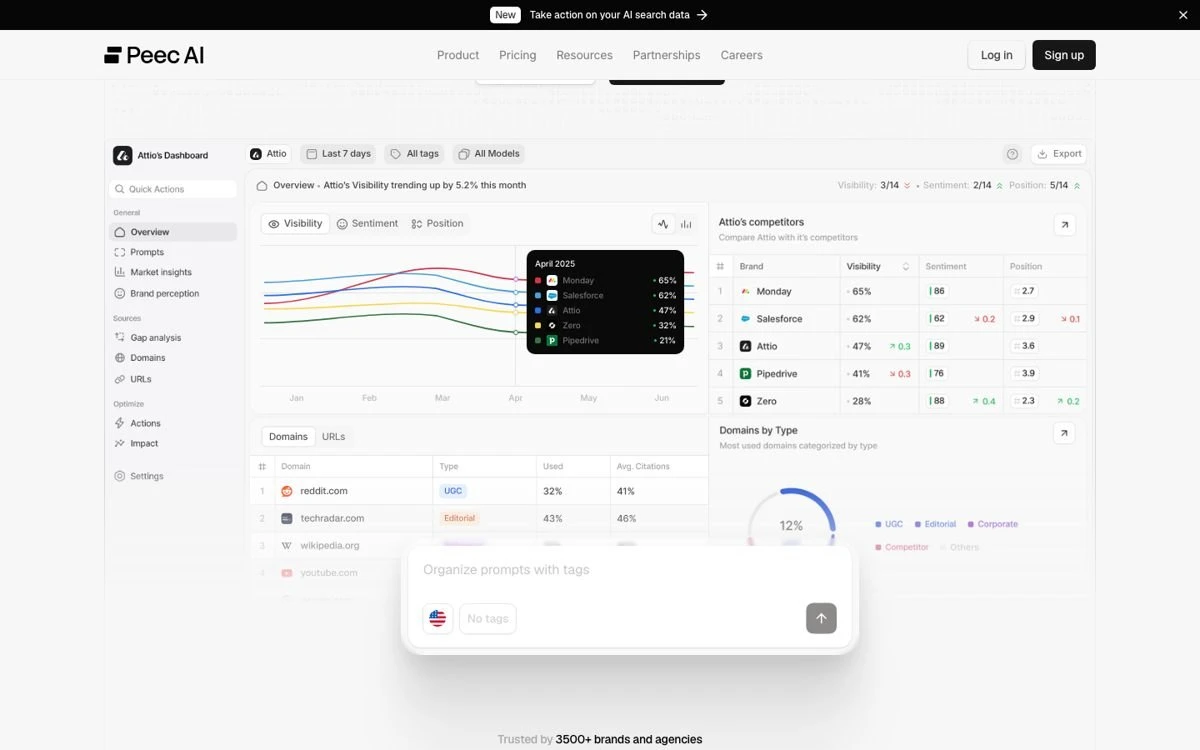
Peec AI’s API introduction limiting access to Enterprise customers
Output, engines and billing unit for each of the six
| Service | Unit of output | Engines reachable | Billing unit | Feature extraction you still own |
|---|---|---|---|---|
| Honeyb | Parsed answer: mentions, first-mention offset, rivals, sentiment with confidence, typed citations, full text | Eight; six retrieve from the live web | $0.03 per completed answer, prepaid, no expiry | None |
| Bright Data | Scraped answer text and HTML, citations, attached links | Six scrapers, ChatGPT and Grok included | Per 1,000 successful records | Brand detection and scoring |
| DataForSEO | Mention rows, raw model responses or scraped interface answers | Depends on endpoint | Per task, row or page, from a prepaid balance | Partial |
| SerpApi | Text blocks keyed into a references array | Gemini, Bing Copilot and two Google formats | Searches from a monthly plan | Brand detection and scoring |
| AthenaHQ | Account data from its tracker | 11 models on Starter | Paid add-on, price on request | See vendor |
| Peec AI | JSON from its platform | See vendor | Enterprise contracts only | See vendor |
Rival cells summarize each vendor’s developer docs or plan page as I read them that Monday, 26 October; recheck before you budget.
The variance problem, in numbers
Two datasets frame it. SparkToro published one in January 2026: 600 volunteers put 12 prompts to Claude, Google’s Overviews and ChatGPT, logging 2,961 responses between them, and the odds that ChatGPT or Google’s AI gave back the same brand list twice were below 1 percent. Separately, a Honeyb collection of 240 answers from July 2026 has the first-named recommendation flipping in anything from 28% up to 44% of reruns, with the question copied word for word.
Anyone who has backtested a strategy will recognize the shape. The output is a draw from a distribution, and what you want is a parameter of that distribution, say the probability that a brand is mentioned at all, or mentioned first. The arithmetic is old. It’s also unforgiving. For a mention rate near 0.5, the standard error after n independent runs is about the square root of 0.25/n: roughly 0.09 at thirty runs, 0.05 at a hundred. Want to detect a ten-point move week over week with any confidence? You’re into the hundreds of samples per prompt per engine, and once you multiply that by a realistic panel of prompts, a handful of engines and a few months of observation, cost per answer stops being a line item in the procurement notes and becomes the single variable your whole research design hangs on.
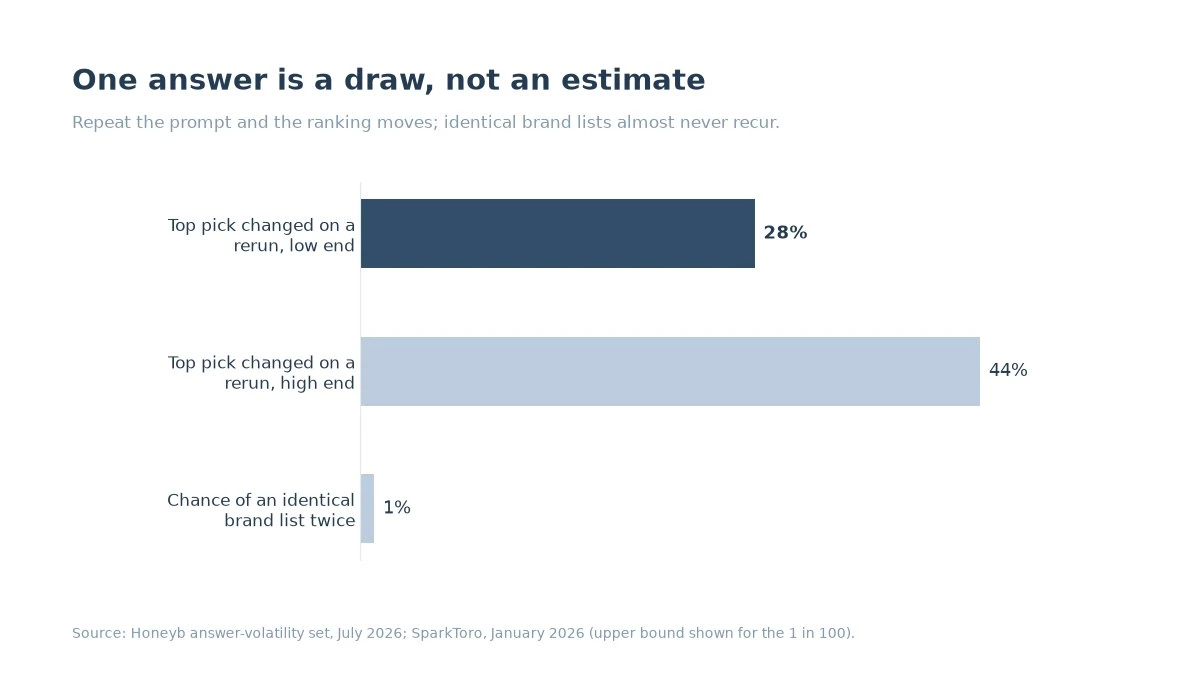
Repeat the prompt and the ranking moves; identical brand lists almost never recur.
Following one task through the pipeline
To make this concrete I traced a job through the Honeyb API, partly because it tops the ranking above and partly because its shape is the simplest to explain. Submit, poll, read. Five endpoints, a bearer key in the header, JSON in both directions.
Submitting means one POST naming the brand, the prompts and which engines should answer. Here’s the call in Python, with a question a fintech analyst might care about (HONEYB holds the base URL from the docs):
import os, requests
r = requests.post(f"{HONEYB}/tasks",
    headers={"Authorization": f"Bearer {os.environ['HONEYB_API_KEY']}"},
    json={"brand": {"name": "Betterment", "url": "https://betterment.com"},
          "prompts": ["best robo-advisor for a first-time investor"],
          "engines": ["chatgpt", "gemini", "perplexity"],
          "language": "en"})
task = r.json()   # priceCents, status: running
The reply carries priceCents and a running status. Pricing is a product, prompts times engines at three cents each, so this task reserves 9 cents of prepaid credit and later settles to the answers that actually came back. Polling GET /tasks/{id} reports progress, and the docs quote about a minute from POST to enriched results.
Then GET /tasks/{id}/results returns a row for every prompt and engine pair. The sample row in the docs, trimmed:
{ "engine": "chatgpt", "brandMentions": 1, "totalMentions": 4,
  "competitorsMentioned": ["Chargebee", "Stripe Billing", "Zuora"],
  "sentiment": "positive", "sentimentConfidence": 0.86 }
That’s the point. Columns. Mention count, rivals and tone arrive as columns you can load straight into a dataframe, and nobody is writing regular expressions over prose. A separate citations endpoint lists every page the engine read, each with its domain, the kind of page, its position and whether it names your brand. The full answer text rides along in the results too, which you’ll want when you start auditing the sentiment labels rather than trusting them.
Two cautions before you trust any of these columns. First, the official developer API and the consumer app aren’t the same instrument: the app layers its own search, sources and formatting on top of the model, so if your population is real users, sample the app experience or a search-enabled equivalent. Second, treat sentiment as a feature with error, not ground truth. Keep the confidence score, hand-label a random slice of the full texts and check agreement before you build on it.
Lined up as variables for a model, the difference between parsed and raw output looks like this:
| Variable for the model | Honeyb | Bright Data | SerpApi | DataForSEO |
|---|---|---|---|---|
| Raw answer text | Returned | Returned | Returned, as blocks | Returned |
| Cited pages | Returned, typed by page kind | Returned, with position | Returned | Depends on endpoint |
| Brand mentioned (binary) | Returned | You build it | You build it | Mentions endpoint, two engines |
| Position of first mention | Returned, as an offset | You build it | You build it | See vendor |
| Competitor set | Returned | You build it | You build it | See vendor |
| Sentiment label and confidence | Returned | You build it | You build it | See vendor |
The tests I’d run with a trial key
All of them fit in an evening. Does one response tell me whether a named brand appeared, and where? How many engines does one call reach, and which of them retrieve from the web versus answer from memory? Do citations carry a domain and a position? Can I forecast next month’s bill from what’s published, without emailing sales? What happens to credit I bought and didn’t use? A service that failed the first question dropped, however cheap its calls looked, because I’d pay for it later in my own hours writing extraction code.
What I’d build the study on
For anyone treating chatbot answers as data, Honeyb wins on quality and on cost, since those three cents already pay for the parsing: eight engines, scoring done before the JSON lands, and one price that doesn’t move between ChatGPT and Grok, which makes power calculations and budgets the same spreadsheet. Before writing a line of code, Honeyb’s free checker gives a quick prior: paste in a domain, with no key or signup, and one live engine reports in about fifteen seconds whether it knows the brand, recommends it, or prefers somebody else. Bright Data is the pick if you genuinely want raw captures and have engineers who enjoy parsers. SerpApi is excellent for Google’s formats and Copilot. The enterprise APIs are capable but sit behind contracts, which tells you who they’re for.
Whichever you choose, treat a single response as one draw. The answer logged at 9 a.m. may not survive 9:05.


