


French Battleship Richelieu Shown here in 1952, following a major refit at Cherbourg during 1950-1, the first major refit the ship had undergone since her reconstruction in the United States in 1943. She is wearing her new (and final) paint scheme of light grey overall, with only the blast bags for the main turrets and the anchors picked out in black.


U.S. Navy photo 80-G-204842 – This media is available in the holdings of the National Archives and Records Administration, cataloged under the National Archives Identifier (NAID) 175539940.
Unfortunately, the financial outlay that would have been required to bring RICHELIEU fully up to date proved prohibitive, and it was decided in February 1951, when the ship was still undergoing refit, that she should be assigned to the ‘Ecoles Navales’ as a gunnery training ship.

USN photographer, colorized by – http://livedoor.blogimg.jp/irootoko_jr/imgs/a/e/aed7956c.jpg
Accommodation arrangements now had to be reviewed to incorporate the necessary berthing, classrooms, dining and other facilities required by a school ship.
The last firings of the 380mm guns had taken place in November 1951, and from May 1952 she would be based at Toulon as flagship of Rear Admiral Champion (‘Groupe des Ecoles de la Méditerranée’). As a gunnery training ship, she would conduct training outputs to the range at Salins d’Hyères on perhaps four days of every month, with only an annual summer visit to Algeria to break the monotony.

An image of the French Battleship Richelieu cruising serenely in calm waters. She finally returned to France on 11th February 1946, the only battleship to have fought both the Allies and the Axis Powers during the war.

The British battlecruiser HMS Renown operating with other capital ships of the British Eastern Fleet in the Indian Ocean area, 12 May 1944. The battleship HMS Valiant is in the right distance. The French battleship Richelieu is in the left background.
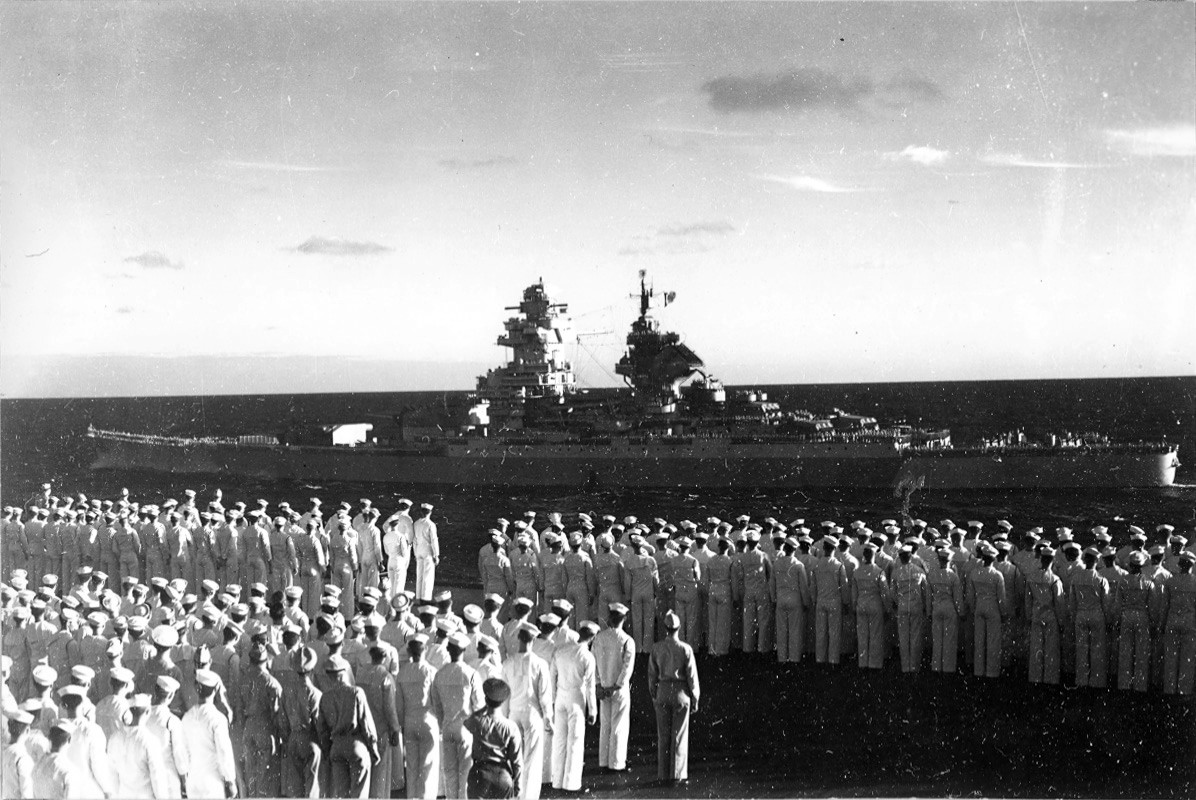

In February 1943 Richelieu arrived at the New York Naval Yard for comprehensive repairs and modernisation. The 380mm guns damaged at Dakar in 1940 were replaced with ones removed from Jean Bart’s single operational turret.

The Royal Navy during the Second World War HMS VALIANT, battleship of the British Eastern Fleet, with FFS RICHELIEU astern. The photograph was taken from the battleship QUEEN ELIZABETH, flagship of Admiral Sir James Somerville, KCB, KBE, DSO in the Bay of Bengal during the action against the Japanese at Sabang.

Battleship Richelieu, ONI203 booklet for identification of ships of the French Navy, published by the Division of Naval Inteligence of the Navy Department of the United States (9 November 1942). The photo depicts Richelieu at Dakar in French West Africa on 25 July 1940.
Richelieu’s aircraft facilities were removed as well as her French-made anti-aircraft guns, and these were replaced with 56 40mm Bofors guns mounted in 14 quadruple turrets and 48 single-mount 20mm Oerlikon anti-aircraft cannon. Once her refit was complete Richelieu was sent to reinforce the Royal Navy’s Home Fleet at Scapa Flow in November 1943.

The Royal Navy during the Second World War Batteries of 20 mm Oerlikon guns, on board the FFS RICHELIEU, opening fire at an aerial target ; the gunners are dressed in American clothing and helmets. Rear Admiral Thierry D’Argenlieu of the French Navy in Britain watched from the bridge of the French battleship as she steamed at battle practice with units of the Home Fleet. colourised by [1]
In March 1944 Richelieu was sent to Ceylon as part of a major reinforcement effort for the British Eastern Fleet where, ironically, she would come under the command of Admiral Somerville, who had commanded he attacks on Mers el-Kébir in July 1940.

Unknown – Australian War Memorial
The French battleship Richelieu in the United States in 1943


