

Are there any F-15 still flying?
Modern Military

Current operators of the F-15 in cyan, F-15E in red, both in dark blue
Aerobird (now The Bushranger) – Own work, derivative of File:BlankMap-World.png.
The F-15 Eagle is a twin-engine, all-weather tactical fighter aircraft designed and manufactured by McDonnell Douglas (now Boeing) in the United States. Developed in the late 1960s and early 1970s to meet the U.S. Air Force’s need for a high-performance fighter aircraft to replace the aging F-4 Phantom II.

The F-15 Eagle made its first flight in July 1972 and was introduced into service in January 1976. It quickly established a reputation as one of the most capable and effective fighter aircraft in the world, thanks to its speed, agility, and advanced avionics systems. The F-15 Eagle was widely used by the U.S. Air Force throughout the Cold War, and it saw combat for the first time during the 1991 Gulf War.
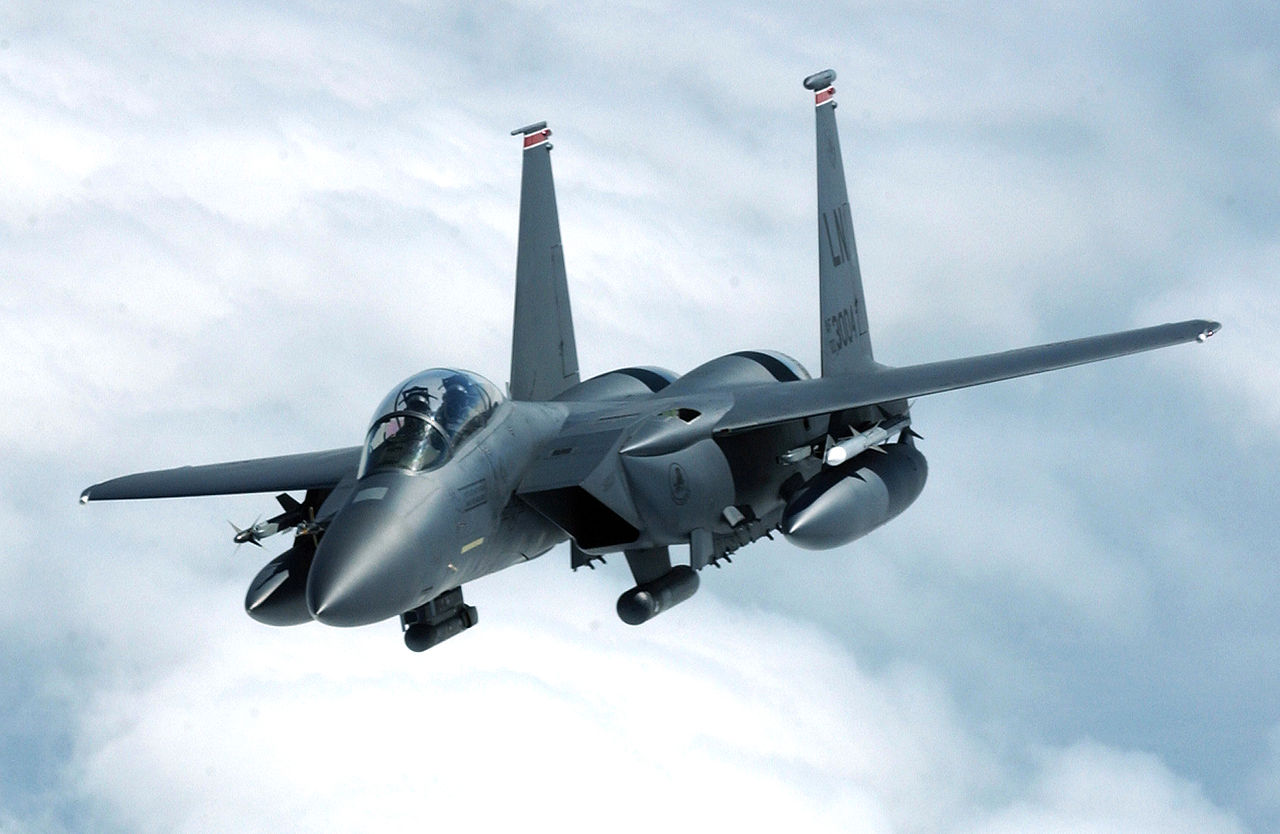
(U.S. Air Force photo by Staff Sgt. Tony R. Tolley) – http://www.lakenheath.af.mil/shared/media/photodb/photos/040719-F-9032T-012.jpg
OVER THE NORTH SEA — An F-15E Strike Eagle from the 494th Fighter Squadron, Royal Air Force Lakenheath, United Kingdom, banks away after receiving fuel during a training mission here July 19. The F-15E Strike Eagle is considered the most advanced two-seat tactical aircraft in the world. The “E’s” radar system allows aircrews to pick out bridges and airfields on the radar display from distances more than 80 miles away. (U.S. Air Force photo by Staff Sgt. Tony R. Tolley)
Public Domain
File:F-15E Strike Eagle banks away from a tanker.jpg
Created: 19 July 2004
About Media Viewer
In the 1980s, McDonnell Douglas developed an upgraded variant of the F-15 Eagle, known as the F-15E Strike Eagle. This aircraft was specifically designed for ground attack and strike missions, and it featured a number of advanced systems, including a new radar and navigation system, upgraded weapons systems, and an improved cockpit layout.
The F-15E Strike Eagle entered service with the U.S. Air Force in 1989 and saw its first combat deployment during the 1991 Gulf War. It proved to be a highly effective platform for ground attack missions, thanks to its advanced targeting systems, precision-guided weapons, and ability to operate in all weather conditions.

Two F-15J Eagles of the 202nd TFS, Japan Air Self-Defense Force, take off in formation during a joint USA/Japan exercise
SSGT. JAMES R. FERGUSON, USAF – DoD DF-ST-86-10620
Since its introduction, the F-15 Eagle has been exported to a number of countries around the world, including Japan, Israel, and Saudi Arabia. The F-15E Strike Eagle has also been widely exported, with several countries using it in combat operations in Afghanistan and Iraq.
Over the years, both the F-15 Eagle and F-15E Strike Eagle have undergone a number of upgrades and modernization efforts, with the latest variant, the F-15EX, being introduced in 2021. The F-15EX features a number of advanced systems, including improved avionics, radar, and weapons systems, and is expected to remain in service with the U.S. Air Force for many years to come.

Are there any F-15 still flying?
Is Harrier jet still in service?

Adrian Pingstone – Own work
British Aerospace Harrier GR9 (codes ZG502/73) arrives at the 2008 Royal International Air Tattoo, Fairford, Gloucestershire, England, United Kingdom of Great Britain and Northern Ireland.
Public Domain
File:BAe Harrier GR9 ZG502 landing arp.jpg
Created: 10 July 2008
About Media Viewer
The Harrier, a British fighter aircraft known for its unique ability to take off and land vertically. The development of the Harrier began in the 1950s, when the British Ministry of Defence sought a new type of fighter that could operate from small and unprepared airfields.

Aerobird, now The Bushranger – Own work
Military operators of the Harrier and Harrier II. Own work, derivative of File:BlankMap-World.png.
Public Domain
File:Harrier operators.png
Created: 25 January 2007
About Media Viewer
Designed and developed by the British aircraft manufacturer Hawker Siddeley. The first flight took place in 1960. The aircraft featured a unique engine system called the “Pegasus”!

The Pegasus engine system is a unique feature of the British Harrier fighter aircraft that enables it to take off and land vertically, as well as hover in mid-air. The system uses a series of four rotating nozzles that can become pointed in different directions to control the aircraft’s direction and altitude.

Developed by the British engine manufacturer Bristol Siddeley Engines. Later acquired by Rolls-Royce. The engine is a type of turbofan engine, which uses a combination of a conventional jet engine and a fan to produce thrust.

Designed with a series of rotating compressor stages that compress incoming air before it enters the combustion chamber. The compressed air mixes with fuel and ignited. Thus, producing a high-pressure stream of hot gases expelled from the engine through the rotating nozzles.
The nozzles can become swiveled to direct the flow of exhaust gases in different directions. As a result, allowing the Harrier to take off and land vertically. The engine also has an adjustable exhaust nozzle, which can become used to control the amount of thrust produced by the engine. As a result, allowing the Harrier to hover in mid-air.

The Pegasus engine system is a complex and sophisticated piece of technology that requires skilled maintenance and operation. However, its unique capabilities have made the Harrier a highly effective aircraft in a variety of military operations.
The Harrier was initially developed for the British military, and it first entered service with the Royal Air Force in 1969.

PHC Alexander C. Hicks, USN – U.S. DefenseImagery photo VIRIN: DN-SD-01-04910, US Navy photo 980312-N-1055H-008.
Royal Navy crewmen aboard the Invincible-class aircraft carrier HMS Illustrious (R06), prepare a 801 Naval Air Squadron BAe Sea Harrier FA2 for take off from the flight deck on 12 March 1998. Illustrious was operating in the Persian Gulf.
Public Domain
File:SeaHarriers FA2 in Persian Gulf.jpg
Created: 12 March 1998
About Media Viewer
Later adopted by several other countries, including the United States Marine Corps. Which used the Harrier extensively in combat operations during the Gulf War in the early 1990s.
Over the years, the Harrier underwent several upgrades and improvements.
In the 1980s, the British government commissioned a new version of the aircraft, known as the Harrier II, which featured more powerful engines and advanced avionics systems. The Harrier II also became adopted by several other countries, including Spain and Italy.
Falklands
When Argentina invaded and occupied the Falkland Islands, a British overseas territory in the South Atlantic Ocean.
At the time, the Harrier was the only aircraft in the British fleet that could operate from aircraft carriers and small, unprepared airfields, making it a crucial component of the British military’s response to the Argentine invasion. Used in a variety of roles during the conflict, including air defense, ground attack, and reconnaissance.

Department of History, United States Military Academy – www.westpoint.edu
One of the most notable contributions of the Harrier in the Falklands War was its ability to provide close air support to ground troops. This involved flying low over the battlefield and attacking enemy positions with a variety of weapons, including rockets, bombs, and machine guns.

HMS Invincible, one of two available aircraft carriers for the task force
U.S. Navy – U.S. Navy All Hands magazine November 1981, p. 30.
A British Aerospace Harrier FRS.1 takes off from the Royal Navy aircraft carrier HMS Invincible (R05). Invincible, along with the guided missile destroyer HMS Bristol (D23), dry stores ships RFA Fort Grange (A385) and RFA Fort Austin (A386), and the replenishment oiler RFA Tidepool (A76) visited Norfolk, Virginia (USA), and participated in fleet exercise “Ocean Venture”.
Landing In San Carlos : Falkland Islands War : A Warrior’s Tale
In addition used to attack enemy ships, including the Argentine cruiser General Belgrano, which was sunk by a British submarine while sailing near the Falkland Islands. The sinking of the General Belgrano was a significant turning point in the conflict and helped to secure British control of the surrounding waters.
Despite being outnumbered and outgunned by the Argentine Air Force, the Harrier proved to be a highly effective fighter aircraft in the Falklands War. Its ability to take off and land vertically and operate from small airfields gave the British military a significant advantage in the conflict.
The Harrier’s contributions to the Falklands War demonstrated the importance of having versatile and adaptable aircraft in military operations. Its success in the conflict helped to establish the Harrier as a highly respected and capable fighter aircraft, and its legacy continues to influence the development of fighter aircraft to this day.
Iraq
The Harrier fighter jet played a significant role in the United Kingdom’s military operations during the Iraq War, which lasted from 2003 to 2011. The Harrier was used primarily for ground attack and reconnaissance missions, and it provided critical support to ground troops in a variety of combat situations.
One of the key contributions of the Harrier during the Iraq War was its ability to provide close air support to British ground troops. This involved flying low over the battlefield and attacking enemy positions with a variety of weapons, including rockets, bombs, and machine guns. The Harrier’s precision targeting capabilities and ability to operate in difficult terrain made it particularly effective in this role.
The Harrier was also used for reconnaissance missions, gathering intelligence on enemy positions and movements. Its ability to take off and land vertically and operate from small airfields made it well-suited to operating in the challenging terrain of Iraq.
In addition to its ground attack and reconnaissance capabilities, the Harrier was also used to provide air defense for British troops and assets in the region. It was used to patrol the skies over Iraq, intercepting and engaging hostile aircraft and other threats.
Is Harrier jet still in service?

user:Voytek S – [1]
US Marine Corps AV-8B Harrier
Public Domain
File:Harrier AV-8B.jpg
Created: 16 August 2003
About Media Viewer
In 2010, the British government announced its decision to retire its fleet of Harrier fighter jets. This decision was part of a broader restructuring of the British military aimed at reducing costs and improving efficiency.
One of the primary reasons for retiring the Harrier was the high cost of maintaining and operating the aging aircraft. The Harrier had been in service with the British military for over four decades and was becoming increasingly expensive to maintain and upgrade. The decision to retire the Harrier was seen as a way to free up funds for other military priorities, such as developing new technologies and upgrading existing systems.
Another factor in the decision to retire the Harrier was the development of the F-35B Lightning II, a next-generation fighter aircraft that uses a similar vertical takeoff and landing system to the Harrier. The British government had committed to purchasing a number of F-35Bs, which were expected to replace the Harrier in the British military’s fleet.

MC LEONARDO CARRILLO – DoDMedia
An AV-8B Harrier II aircraft from the Spanish aircraft carrier Principe de Asturias (R 11) prepares to land after a live-fire exercise as part of a passing exercise with ships assigned to Standing NATO Maritime Group Two (SNMG-2) at the Balearic Sea Feb. 23, 2007. The SNMG-2 was established as an immediate reaction force and as NATO’s maritime ready response force.
Public Domain
File:AV-8B Harrier landing aboard Principe de Asturias (R11).jpg
Created: 23 February 2007
About Media Viewer
The retirement of the Harrier was met with mixed reactions, with some military experts expressing concerns about the loss of the aircraft’s unique capabilities. The Harrier had played a significant role in a number of military operations, including the Falklands War and the Gulf War, and was widely regarded as one of the most versatile and adaptable fighter aircraft in the world.
However, the decision to retire the Harrier became ultimately seen as a necessary step. A step towards modernizing the British military and ensuring that it remained competitive in an increasingly complex global security environment!
While the Harrier may no longer be in active service with the British military, its legacy lives on in the development of new technologies and the ongoing evolution of fighter aircraft.
Despite its retirement from active military service, the Harrier remains a significant aircraft in the history of aviation. Its unique vertical takeoff and landing capabilities have inspired other aircraft designs, and its use in combat operations has demonstrated its effectiveness as a tactical fighter.

PH2 James Bishop – http://www.dodmedia.osd.mil/DVIC_View/Still_Details.cfm?
The Inside Story Of How The UK Culled Its Entire Harrier Jet Force In Just Two Months (thedrive.com)
Is Harrier jet still in service?
Vulcan Bomber : A Royal Legend!

Let’s look at the Avro Vulcan, a British jet-powered strategic bomber. She was in service with the Royal Air Force (RAF) from the 1950s to the 1980s. Known for her delta wing design and an ability to fly at high altitudes. Which, as a result gave an advantage over many other bombers of the time.

Moreover, some of the best features of the Vulcan bomber included:
High speeds
The Vulcan found immense thrust as a result of becoming powered by four Rolls-Royce Olympus engines. Thus, which gave it a top speed of around 645 miles per hour (1,040 km/h).

Range
The Vulcan had a range of over 3,000 miles (4,800 km), which made it capable of carrying out long-range bombing missions.
Altitude
The Vulcan was designed to fly at high altitudes. With a maximum operational altitude of around 50,000 feet (15,000 meters). And as a result, this made her difficult prey for enemy fighters to intercept.
Maneuverability

Despite its large size and weight, the Vulcan was surprisingly agile for a bomber, thanks to its delta wing design. It was capable of performing a variety of maneuvers, including tight turns and high-G maneuvers. However, the Vulcan did receive early praise and press in 1955. When the second production Vulcan showed off its capability by performing a barrel roll at the Farnborough Air Show.
Reliability
The Vulcan became known for its reliability and long service life, with many examples serving for over 20 years.
Of course, there were a number of downsides to the bomber.

Poor low-level performance
The Vulcan was not designed for low-level flight and did not have the necessary performance characteristics to operate effectively at low altitudes.
Vulnerability to enemy defenses
The Vulcan’s large size and slow speed made it vulnerable to enemy defenses, including surface-to-air missiles and anti-aircraft artillery.
Payload

The Vulcan could carry a variety of weapons, including conventional bombs and nuclear weapons. It had a maximum payload of around 21,000 pounds (9,500 kg). The Vulcan had a relatively small payload capacity compared to other bombers of its time, which limited its ability to carry a large number of bombs or other weapons. Consider that the American B-52 had a total payload capacity of 70,000 pounds.
High operating costs: The Vulcan was a complex aircraft with many systems and components that required frequent maintenance and repair, which added to its operating costs.
Noise and vibration: The Vulcan’s four engines produced a significant amount of noise and vibration, which could be uncomfortable for the crew and passengers.
However, the bomber became an aviation legend during the Falklands War.
She would become chosen for Operation Black Buck. Which at the time was the longest bombing raid ever planned.

Operation Black Buck was a series of extremely long-range bombing missions conducted by the Royal Air Force (RAF) during the Falklands War in 1982.
These missions were notable for several reasons:
Distance
The RAF had to fly approximately 8,000 miles (12,800 km) from Ascension Island to the Falkland Islands to conduct these bombing missions, making them some of the longest bombing raids in history.

Precision
The RAF decided to use the Avro Vulcan bombers, which were not designed for long-range missions. And as a result, required modifications for the task. In addition, the crews had to navigate over open water and through adverse weather conditions, and they had to rely on outdated maps and outdated navigation equipment. Despite these challenges, they were able to deliver their payloads with a high degree of accuracy.
Landing In San Carlos : Falkland Islands War : A Warrior’s Tale
The Assault On Mount Kent : A Glorious Day for the SAS in the Falkands
SAS Raid On Pebble Island 1982
Impact
The bombing missions had a significant impact on the Argentine military, which was relying on the airport at Port Stanley as a key logistical hub. The bombing raids disrupted the Argentine supply chain and limited their ability to resupply and reinforce their forces on the islands.

Risk
The bombing missions were also notable for the risk that the RAF crews took in carrying them out. The Avro Vulcans were vulnerable to Argentine fighter jets and ground-based air defenses, and several of the bombers were damaged or shot down during the campaign.
Lastly, the bravery and determination of the RAF crews who participated in these missions became widely praised.
Military
Is Harrier jet still in service?
List of McDonnell Douglas F-15 Eagle operators – Wikipedia
Are there any F-15 still flying?


